For all the slackness of its opening, the 2004 Swedish film that was nominated for an Academy Award in the Best Foreign Language Film category (
As It Is in Heaven) deserved the nomination, if only for the glorious ending to which it ascended.
Så som i himmelene [As It Is in Heaven] (2004: Kay Pollak) [Successful international conductor Daniel Daréus (Michael Nyqvist, who co-stars in The Girl with the Dragon Tattoo) suddenly interrupts his career and returns alone to his childhood village in Norrland, in the far north of Sweden. It doesn't take long before he is asked to come and listen to the fragment of a church choir, which practises every Thursday in the parish hall. Just come along and give a little bit of good advice. He can't say no, and from that moment, nothing in the village is the same again. The choir develops and grows. He makes both friends and enemies. And he finds love (Frida Hallgren)] [EO] 5-23-2012
The ending is the kind of all-come-together-in-music moment that I think the impresario of American Music Week in Bulgaria would love—and love to see happen again and again during his
AmBul festivals. (I speak of my son. Do watch this movie, Geoff!)
As far into the movie as five to ten minutes (I didn't note the time), I felt bored and ready to try something else, but by the ten-to-fifteen-minute mark I was well hooked by what was becoming a solidly compelling story, as Daniel Daréus latched onto the possibility he saw in the church choir he was asked to come and listen to. In the course of a few weeks, he literally transforms not only the choir itself, but most of its members, who, in responding to Daniel's challenge to find their "own tone," learn even more about themselves and each other.
One of the members is Gabriella (Helen Sjöholm), whose husband (Conny) frequently beats her and becomes predictably jealous of Daniel (who finally realizes that Conny was one of the schoolboys who bullied him). In a stirring act of compassion and understanding, Daniel draws Gabriella out by composing a song for her to sing solo in their upcoming concert. Reluctant (even refusing) at first, she assents and her performance is greeted at first by a stunned silence in the awed audience before it breaks into thunderous applause.
You can hear Sjöholm's performance on YouTube:
My title comes from the song's lyrics, and I found an English translation of Gabriellas Sång (side-by-side with the original Swedish) at
http://lyricstranslate.com/en/gabriellas-sang-gabriellas-song.html.
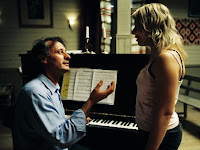 |
| Daniel & Lena |
However, Gabriella's Song is
not the movie's ending. Nor is Gabriella the love referred to in the synopsis above (see picture at right). I believe that if you share my taste in movies at all you'll like this one very much and thrill at the joy it provokes.
There is a spirituality to it, and I'm sure that many will consider the movie religious (the title, after all). But in some ways it's more anti-religious than religious. The pastor's wife (Inger) is so transformed by the truth she discovers by participating in the choir that she is able to tell her husband for the first time what a hypocrite he is.
In misguided self-defense, the pastor gets Daniel ousted from his formal leadership of the choir—with the cinematically pleasing result that Inger moves out and the choir separates itself from the church.
When the pastor asks Inger whether she will come back to him, she says she doesn't know. Maybe the following lines from Gabriella's Song catches where Inger is at this point:
I want to feel I’m alive
All my living days
I will live as I desire
I want to feel I’m alive


.jpg)


