Welcome statement


“Parting Words from Moristotle” (07/31/2023) tells how to access our
archives of art, poems, stories, serials, interviews, travelogues….
Showing posts with label free will. Show all posts

Monday, April 17, 2023

From “The Scratching Post”:
Free will

By Ken Marks

[From the original on The Scratching Post, April 14, 2023, published here by permission of the author.]

Norm and I have been friends since high school. We still see each other occasionally, and a few weeks ago, we had Norm and his wife, Susan, at our house for dinner. Afterward we sat and talked in our family room. Inevitably, the conversation became political. I say inevitably because Norm is to the left of me, and only politically obsessed people are to the left of me.
    Norm had the shootings at the Nashville Covenant School on his mind. I knew he’d been agonizing over it because our gun culture is the hottest of his hot buttons. He wants the government to seize every firearm in the country with no questions asked. After that, he’s OK with allowing a federal agency to issue gun licenses, but only under the most extreme circumstances – like, you’re a celebrity with a history of being stalked or a gay living in Buffalo, N.Y.1 I’d be much more lenient with gun owners. You can own a gun but only a hand gun. No clips over 8 rounds. No history of antisocial behavior or mental illness. Licensing, registration, and gun insurance required.
    Norm and I went back and forth about whose gun control plan was better, and then the conversation took an unforeseen turn …2

Norm: Ya know what I will never understand, Ken? How can anyone decide to kill innocent people, and complete strangers besides? Yeah, I know what you’ll say. Many shootings are simply hate crimes, but still … the victims probably had loved ones and dreams of the future. And many, especially children, don’t have an unkind bone in their bodies. How can anyone choose to do something so evil?

Me: You say “decide” and “choose,” Norm. It sounds like you believe the shooter acted with volition; she had a free choice, to kill or not to kill, and she chose to kill – consciously, deliberately.....
______________
[Read the rest on The Scratching Post.]


Copyright © 2023 by Ken Marks
Ken Marks was a contributing editor with Paul Clark & Tom Lowe when “Moristotle” became “Moristotle & Co.” A brilliant photographer, witty conversationalist, and elegant writer, Ken contributed photographs, essays, and commentaries from mid-2008 through 2012. Late in 2013, Ken birthed the blog The Scratching Post. He also posts albums of his photos on Flickr.

Thursday, January 3, 2013

Thor's Day: The tie that binds

By Morris Dean

The English word "religion" derives through Old French from the Latin religiō, whose ultimate origins are obscure, but some modern scholars favor the derivation from ligare (bind, connect), probably from a prefixed re-ligare, i.e., re (again) + ligare, or "to reconnect." [Wikipedia]

Sunday, July 1, 2012

Them's the breaks

Bryan Cranston stars
as Walter White
Episode 5 in Season 1 of Breaking Bad ("Gray Matter," which aired on February 24, 2008) features a speech by high school chemistry teacher Walter White that could have informed Sam Harris's thinking about free will.
    In the first episode, Walter was diagnosed with terminal lung cancer and resorted to selling crystal methamphetamine to provide for his family when he is dead. But he didn't let his wife (Skyler) know he was sick until the fourth episode.
    Having learned the news, Skyler becomes determined that Walter will undertake chemotherapy, and she doesn't hesitate to let Walter's wealthy former graduate school research partner know or to urge Walter to accept his old colleague's offer to pay for everything.
    But Walter resists.
    In an emotional power play, Skyler engineers an intervention to show Walter how much his family loves him and needs for him to do the therapy. Her sister and brother-in-law don't behave as she expects, they think it should be Walter's decision.

But can it be Walter's decision? That's the question Sam Harris raises.
    Walter responds in as affecting a speech as you can hear in television drama (or in feature film):
Sometimes I feel like I never actually make any of my own choices. My entire life, it just seems I never had a real say about any of it. With this last one—cancer—all I have left is how I choose to approach this...What good is it to just survive, if I am too sick to work...?I choose not to do it.
    [I didn't think I could quote that verbatim, given the difficulty of writing down dialogue from a Netflix download, but then I thought of YouTube, where you can actually see the scene:]


    So, Walter refuses...until, as usually happens with all of us, the balance of forces shifts in favor of the stronger ones' tending toward our compliance. "I'll do the therapy."

Friday I asked what if Judeo-Christian ethics had been all-life affirming (rather than in-group-affirming)?
    A friend commented simply that not enough people think and feel the way I do.
    And probably no one in ancient times thought or felt that way. The forces that produced the Judeo-Christian ethic could have produced no other ethic than the one it did produce. And the forces working now can but have us slaughtering and eating animals, fighting to control oil, tearing down mountains to mine coal, driving just the fuel-inefficient automobiles we do, building pipelines across tracts of wilderness, decimating rain forests, continuing to overpopulate the planet.
    Like Walter, we might individually resist—or become conscious that something in us seems to want to resist—but happenings both within us and around us continue to roll on just the way they individually and collectively always have done and always will do. According to the laws of nature.
_______________
Wiktionary on "Them's the breaks"
[follow-up]

Thursday, June 7, 2012

First digiscopes of retirement

Uncropped (click to enlarge)
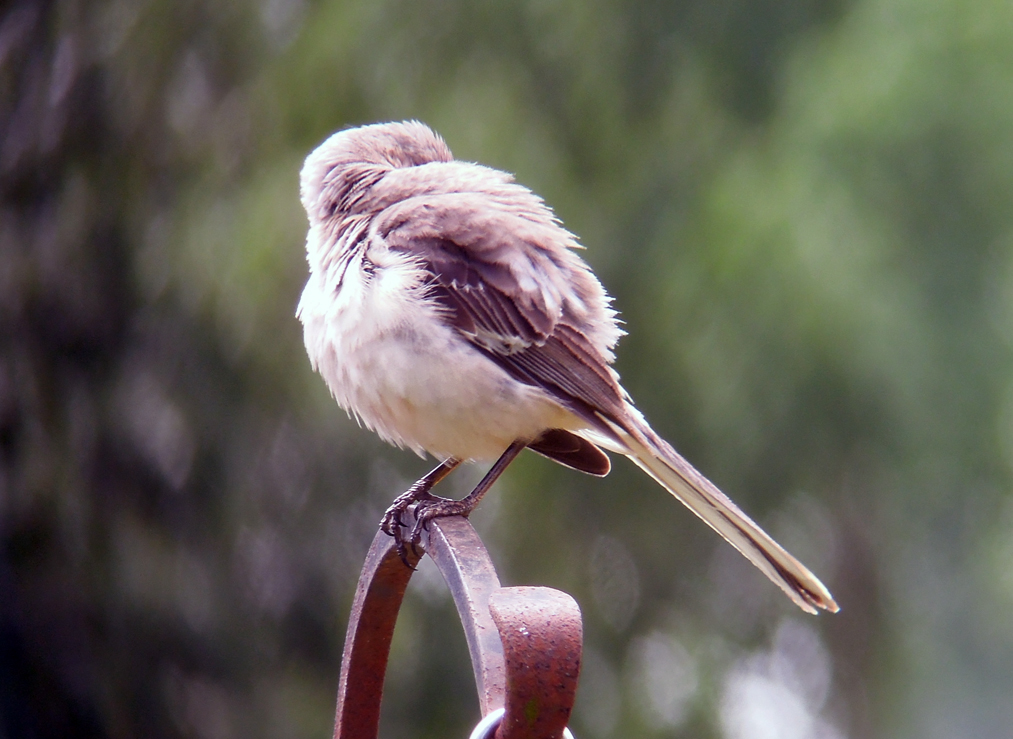
Ironically, having learned from Sam Harris that my free will is only an illusion, I was finally able within a few days of reading his book (Free Will) to get my act together and set up my digiscoping equipment for some bird photographs. My first subject was an obliging Mockingbird, who sat on a bird-feeder pole for as long as I needed for several dozen photos, from which I selected these eleven.


I'm grateful to Mr. Harris for providing ideas that, when added to the potpourri of ideas already ensconced in my synapses, led to my finally doing the first digiscoping of my retirement from UNC. However bereft we may be of actual free will, our lives can continue to provide the illusion that we have it so long as we continue to let new ideas into our heads.

Tuesday, June 5, 2012

Alive morning

My wife and I stood on the patio
beyond the window yesterday  to
view a Green Heron in a distant tree
Thoughts of various pleasing projects ran through my mind as I prepared our breakfast this morning, accompanied by the sort of "meta-thought" that the more immediate thoughts were enlivening me and I appreciated them.
    The pleasing projects weren't earth-shaking, just little, ordinary things that make up my life. Write to someone. Tinker with some wording on a recent post. Ideas for further reflections on the illusion of free will (such as the potential effects of the idea on people, and on people collectively). Set up my digiscoping equipment this week (maybe get a photo of that Green Heron my wife spotted yesterday, or of the Red-headed Wookpecker I thought I saw on a feeder while we were messing with the fieldscope). Deposit that check.
    Thoughts of these ordinary activities enlivened me by distracting me from bodily aches and pains, by engaging me and giving me something to look forward to, by assuring me that the day and the week (and the rest of my life if I am fortunate to have such thoughts every morning) need not be a drag but can ever be adventurous. (Do I hear some of you laughing at the revelation that such activities constitute "adventure" for me?)

And the meta-thought was a bonus—it provided the theme for today's post. Get it done this morning, and then on to, say, digiscoping, which has been neglected so far for thirty-six days of retirement. Not acceptable.
    Get it done this morning, not partially done in the evening then finished the next day, as I confess has been the case with several posts lately. Not acceptable. (But so far a dependable fall-back when needed.)
    Do it now. Be alive now.

Monday, June 4, 2012

What happens

We went to a theater last December to see The Descendants, and we liked it well enough to watch it again, even as early as this afternoon.
The Descendants (2011: Alexander Payne) With his wife Elizabeth on life support after a boating accident, Hawaiian land baron Matt King (George Clooney) takes his daughters on a trip from Oahu to Kauai to confront Brian Speer (Matthew Lillard), the man who was having an affair with Elizabeth before her misfortune.
When we saw it the first time, I don't think I particularly noticed the brief interchange when Hawaiian King confronts Speer to try to find out what happened between Speer and Elizabeth:
King: "How did it happen?"
Speer: "It just happened."
King: "Nothing just happens."
Speer: "Everything just happens."
    I'm sure I noticed it this time because of having read Free Will, by Sam Harris. (I wrote about the reading Friday.)
    The exchange between the two men isn't striking just because Speer summarizes Sam Harris's thesis. Look at the preceding line of dialogue:
Nothing just happens.
    I think that the George Clooney character says that because he's suspicious that Speer, who is a realtor, started the affair to try to gain an advantage in a huge land deal the King family are involved in.
    But out of that context "Nothing just happens" is another way of stating the theistic position:
Everything happens for a reason.
That is, God's in control (or perhaps your guardian angel or angels), and they have a plan....
    Well, if they have a plan, then apparently it calls for quite a few people to believe it...and for the rest not to, and for a good number of the former to believe so strongly that everything happens for a reason that they simply refuse to entertain the possibility that it might not be so. (At any rate, it's people who believe that sort of thing from whom I hear the statement, "You can't make me change my mind.") What a plan.

But seriously, why do people believe that nothing just happens?
    The material world of evolution and "everything just happens" can be very unsettling, as can the facts that people suffer, everyone dies, and justice is not done in this world. Beliefs that deny these realities provide solace. Suffering is for our own good, and it will be made right. We'll be resurrected and live forever (if we follow the right prescription for salvation). God will right the balance of justice at The Last Judgment.
    Solace is the Number One Reason for such beliefs (in the cases where it's not simply that people are paying lip service to the beliefs they've been taught and have never questioned).
    Actually, though, there's a sense in which it's true that nothing just happens—the sense in which happenings have material causes. Believing "nothing just happens" in that sense can inspire a person to try to find out the causes. It can lead to insight, and to science.
    And actually, believing "nothing just happens" in the theistic sense can also inspire a person to look a little deeper into his or her spiritual and moral life, to try to discover why something bad, or something good, or something problematic happened. Insights can be found that way; people can (but may not) become better people as a result. Believing that there's a god and he (usually it's he) has a plan isn't necessarily the end-all of such a believer's life. Life can still be good for such believers (besides the solace). (Hey, I think I really am becoming more accepting of others, just as I said on Friday.)
    The main thing seems to be that we keep looking and seeking and trying to find out. As long as our beliefs inspire that, we're still alive and ticking.

By the way, it would seem from the considerations above that Harris believes both that nothing just happens and that everything just happens. But it's based on an ambiguity.
    He believes that nothing just happens, because everything that happens has causes. And he believes that everything just happens, in the sense that it's an illusion that our free will is one of those causes.

Friday, June 1, 2012

It depends (and so do I)

Click to read the Carl Sagan
quotation (photo source)
For 47 years, I've known that I didn't create myself and do not have the power to sustain my existence for a single moment. I know it has been forty-seven years because I was twenty-two years old when I had a dream that seemed to confirm the dependence, and I'm sixty-nine now. (I described the dream a few years ago, in a post titled "Creatures.")

Sam Harris, in his latest book, Free Will,1 describes a similar situation with respect to what he argues is the illusion of free will:
Take a moment to think about the context in which your next decision will occur: You did not pick your parents or the time and place of your birth. You didn't choose your gender or most of your life experiences. You had no control whatsoever over your genome or the development of your brain. And now your brain is making choices on the basis of preferences and beliefs that have been hammered into it over a lifetime—by your genes, your physical development since the moment you were conceived, and the interactions you have had with other people, events, and ideas. Where is the freedom in this? Yes, you are free to do what you want even now. But where did your desires come from? [p. 40]
Why does Harris argue that free will is an illusion? The main reason (aside from considerations like those above) seems to be that brain activity that signals awareness and initiation of action precedes our conscious awareness of it. When we become aware of an intention, for example, the intention has already happened, and we had nothing consciously to do with it.
How can we be "free" as conscious agents if everything that we consciously intend is caused by events in our brain that we do not intend and of which we are entirely unaware?...People feel that they are the authors of their thoughts and actions, and this is the only reason why there seems to be a problem of free will worth talking about. [p. 31]
    ...From the perspective of your conscious awareness, you are no more responsible for the next thing you think (and therefore do) than you are for the fact that you were born into this world. [p. 36]
    If you pay attention to your inner life, you will see that the emergence of choices, efforts, and intentions is a fundamentally mysterious process....
    You are not in control of your mind—because you, as a conscious agent, are only part of your mind, living at the mercy of other parts. You can do what you decide to do—but you cannot decide what you will decide to do. [p. 38]
Even before reading Harris's book, I had written here about watching myself to see what I would do next, and writing to find out what I thought about something. I had already discovered, from my own personal experience, that what I did and what I thought were things that happened. Harris's book not only serves to confirm this, but also explores some of the implications of it, such as its effect on morality and criminal justice.
    What about its effect on me—or on you if you choose to adopt this way of thinking (or even just experiment with it)?
    I'm still observing its effect(s) on myself. On the one hand, they are, ironically, liberating. I am more accepting of other people (and of myself) the way they are, the way I am.
     But on the other hand, I wonder at times whether I'm missing out on something by giving up the option I thought I had of "using my will power." So far, at least, I haven't missed a day of blogging since my retirement began (one month ago today).
     The jury (the various parts that constitute "me") are still out.

This morning I observed a young woman who lives down the street walking her dogs and letting them defecate in someone else's front yard—fairly near the front door. She didn't pick up the poop, but blithely turned around and led the dogs back home.
     Blithely, did I say? Well, I'm not sure. I think she has to know that not scooping her dogs' poop is unneighborly (and expressly prohibited by the neighborhood covenants), for this has been discussed at some length on our private social network (on the web), of which she and her husband are members. But this is what she does (my wife and I have observed her doing it on a number of other occasions).
    Could I have gone out and let her know that I'd observed her, and reminded her that what she had just done (and had done many times) was wrong? Could I have? I did consider it.
    Some reasons why I think I didn't do it are, first, the prevalent reluctance to "confront" a neighbor, which the people who live in our neighborhood very rarely do. (I'm sure that the vast majority of them have never confronted one of their neighbors—judging by numerous discussions on the neighborhood network. I'm very reluctant to do it myself.)
    Second, I supposed that the young woman has her own reasons for what she did, and that they probably aren't trivial or negligible—doing that seems to be her routine.2
    Third, I was ambivalent about what my motives would have been. If they would have been to "make" her stop leaving the poop (or to stop letting her dogs go in other people's yards), I had little confidence that that would have been the result. She could as easily have become defensive and tried to justify her behavior [see Wednesday's post]. If my motives would have been to demonstrate my "superior neighborliness," what would have been the point of that?
    These considerations passed through my mind. According to Harris, I didn't choose for them to do so; they just did. And I didn't choose not to go confront her; I just didn't.
     It all depended on so many things, one of which apparently wasn't my free will (or hers).
_______________
  1. Free Will (2011: Sam Harris) [A belief in free will touches nearly everything that human beings value. It is difficult to think about law, politics, religion, public policy, intimate relationships, morality—as well as feelings of remorse or personal achievement—without first imagining that every person is the true source of his or her thoughts and actions. And yet the facts tell us that free will is an illusion.
         
    [In this enlightening book, Sam Harris argues that this truth about the human mind does not undermine morality or diminish the importance of social and political freedom, but it can and should change the way we think about some of the most important questions in life. (–The Free Press)]
  2. What if someone had observed Jeffrey Dahmer luring a boy home and gone over to confront him? "That's wrong what you're doing, Jeffrey—you shouldn't kill people or eat their flesh." Might the young neighbor woman have been as unlikely to mend her ways as Jeffrey Dahmer his? Or you or I ours, whatever they are?
         Maybe the answer is "no," but how sure are we?