
Showing posts with label animals. Show all posts
Showing posts with label animals. Show all posts
Friday, March 9, 2018


Thursday, December 28, 2017
Eleven Years Ago Today: The Sadness of the Food Chain
 |
| From ChinaDaily |
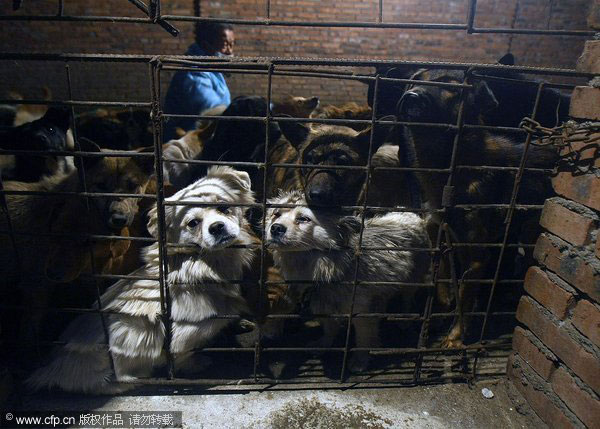
[Originally published on December 28, 2006, without the image added today, purportedly a photo (dated December 15, 2011) of dogs being saved from slaughter in China.]
My “dogs” post of yesterday [December 27, 2006] can be interpreted as expressing a great sadness. And I have to admit I wrote it in a solemn mood. But meditating on the food chain (how animals are violently killed and eaten by bigger or stronger ones) can bring on sadness. Every time I eat flesh I feel sad for the mammal, fowl, or fish that was once alive to enjoy being alive – or not to enjoy it much, if it was raised in a cage only to be slaughtered. In fact, I guess, we are in a sense all in a cage by virtue of the apparent fact that being alive today means we will die tomorrow.
Tuesday, October 10, 2017
On fanciful ideas
By Moristotle
Spellbound at its revelations, my wife and I have been watching Ken Burns’s Vietnam War. Watching it is tearing at my heart, and hers too, I think. The war’s stupidity, our leaders’ pathological need to “save face,” the hundreds of thousands of deaths, square miles of beautiful land burned and bombed, the angst of soldiers, their families, their fellow citizens torn asunder by opposed stances on the war….
Thursday, October 27, 2011
Work imagined in progress
 |
| Software for writing screenplays |
He has already concluded that if he undertakes a larger project, it'll be a screenplay, simply because he knows less about screen writing and would likely learn more from it than from writing another novel1.
He had begun, idly, to wonder what he might write about, realizing that it should be something that he cared enough about to become "passionate" over.
This morning, while heating water for coffee and ruminating over the morality of eating animal flesh when a host serves it to him, he thought of a screenplay about someone (or some group) that tries to do more for animal rights than just becoming a vegetarian or vegan (especially if mostly a "philosophical" one)....
_______________
- In 1974, in one hundred days, he wrote The Unmaking of the President: A Bicentennial Entertainment. Alas, it never found a publisher.
Thursday, January 28, 2010
A dog's life
 In modern life (and perhaps throughout human history), terrible thoughts often come to us. The thought this morning, for example, upon reading that a live teenage girl was found yesterday in Haiti, that the child had spent days under rubble, in pain, thirsty, hungry....And now found, will she survive?
Or the thought that the final seconds of animals raised for slaughter can be spent in a "state of terror." From "Paperback Row," in the January 17 New York Times Book Review:
Animals Make Us Human: Creating the Best Life for Animals, by Temple Grandin and Catherine Johnson. (Mariner/Houghton Mifflin Harcourt, $15.95.) This book picks up where Animals in Translation left off, but the focus here is on animals' emotional lives. "The rule is simple," Grandin writes [not Johnson?]. "Don't stimulate rage, fear, and panic if you can help it, and do stimulate seeking and also play." She has designed humane slaughter systems for cattle, arguing that "no animal should spend its last conscious moments in a state of terror" and that "the most important thing for an animal is the quality of its life".... [emphasis mine; p. 20]We are more human that someone continued looking in that rubble, hope against hope. From the newspaper article (Associated Press) cited above:
French Ambassador Didier le Bret praised the persistence of the French rescue team, which has kept looking for survivors for days after the Haitian government officially called off the search.
 And we are more human that we do the best we can to provide for our pets. I was thinking this morning that the original meaning of the phrase, "a dog's life," probably doesn't cover the kind of life my wife and I try to (and do) provide for Siegfried. Hendrickson's Encyclopedia of Word and Phrase Origins doesn't cover the term. World Wide Words provides the pertinent insight:
Most of our expressions that include dog are old enough to be based in times when dogs were not cosseted, but were kept as watchdogs or hunting animals, not as pets. They often weren’t allowed in the house, but were kept in kennels, fed scraps, worked hard, and often died young. So going to the dogs, dog tired, to die like a dog, dog’s dinner, dogsbody, dog eat dog, and a dog’s life all refer to a state of affairs best avoided. Specifically, a dog’s life is first recorded in the sixteenth century and seems to have remained in the language with the sense of “a life of misery, or of miserable subserviency” ever since....[emphasis mine]But the same article points out that
Those of us over 50 seem to use [the phrase] to suggest the need to accept the existential fact that things are hard; but in the under-50 set, the idea is that dogs have it easy, and so it’s a dog’s life equates to "how cushy"!Now, that latter sense of the phrase does refer to Siegfried!
It certainly seems that the phrase has become more ambiguous than it once was, though I’ve not come across many examples myself of its use as a description of a pampered existence. [emphasis mine]
But what about those animals in the abatoir?
Subscribe to:
Posts (Atom)