Welcome statement


“Parting Words from Moristotle” (07/31/2023) tells how to access our
archives of art, poems, stories, serials, interviews, travelogues….
Showing posts with label Jesus. Show all posts

Tuesday, November 29, 2022

Love your enemies
deciphered in quartina

Click to enlarge
10 Years Ago Today

By Moristotle

[Published originally on November 29, 2012.]

According to the Gospel of Matthew (5:44, King James Version), Jesus said:
But I say unto you, Love your enemies, bless them that curse you, do good to them that hate you, and pray for them which despitefully use you, and persecute you.

Tuesday, November 2, 2021

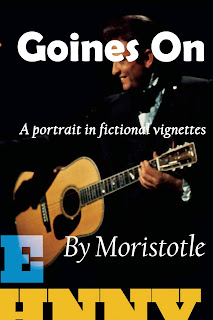
Goines On: Man in Black

Click image for more vignettes
The evening of the day Goines forgot his wallet, the Goineses watched the rest of the Johnny Cash TV Show DVD that a neighbor had lent them, so they could return it to him before he drove them to the airport again. The neighbor loved Johnny Cash; the times he drove them to the airport before, he played Johnny Cash CDs, and they wanted to return the DVD before they took off.

Thursday, June 17, 2021

Goines On: Entrepreneuring

Click image for more vignettes
Goines’ conversation with a young man he met at a family gathering in Virginia stayed with him as he drove himself and Mrs. Goines home on Sunday afternoon. The young man’s profession was business consulting, helping businesses “solve problems and develop strategies.”
    The word “entrepreneur” hadn’t come up in the conversation, but now Goines found himself thinking about his grandson, who wanted to be a successful entrepreneur. His grandson was only a few years younger than the young business consultant, and Goines got to wondering whether the consultant ever counseled young entrepreneurs. Might he be willing to talk with Goines’ grandson?

Friday, May 7, 2021

The Crucifixions

Spread the Word
A Parable of Reversal

By Moristotle

I have revised and retitled the parable “Easter Uprising,” which appeared on April 30, to try to better express my central idea for the poem. A few days after that version appeared, I thought about adding a third stanza, but I quickly saw that some rewording in the second stanza could plant the cross on firmer ground.
    Finally, eight hours before scheduled posting, I made one more change: at the end of the first line of the second stanza, I changed “restoration” to “resurrection.” And then, at last, I saw what my muse may have been trying to tell me all along – the January 6th insurrectionists were, in effect, attempting to resurrect Donald Trump from the crucifixion he seemed to think he had suffered in losing the 2020 presidential election.


Friday, April 30, 2021

Easter Uprising

Spread the Word
A Parable

By Moristotle

God the Father’s people thank Him for resurrection.
His Son had been assailed with “Flog him!”
“Crown him with those thorns!” “Crucify him!”
“Nail his hands and feet!” “Mortify him!”
God‘s people kneel and worship Him for Jesus’ restoration.

Trump’s proud people stand by, they demand his restoration.
They’re very special people; he needs them.
They rally and smash her office; he loves them.
They storm the Capitol. “Get heavy!” “Trash them!”
“Make America great again.” They bring the pain of insurrection.

Copyright © 2021 by Moristotle

Tuesday, September 1, 2020

11 Years Ago Today:
Compassion and Justice

[Originally published on September 1, 2009.]

An email discussion I’ve been having about health care reform with a small circle of Yale classmates recently put me in mind of something I’d read about the political philosopher John Rawls (1921-2002). I’d read, perhaps in an obituary, that he held something like

Saturday, June 20, 2020

Goines On:
Heavenly Productions, Ltd.

Click image for more vignettes
The psychology of “faith the substance of things hoped for” wouldn’t let go of Goines. He wondered about scientists who believe in the divinity of Jesus. Do they accept Christianity’s doctrine of salvation out of a deep need to know things beyond science’s reach, things they can then expect God to reveal to them someday?
    Remembering his college logic studies, Goines thought of another thing the writer of the letter to the Hebrews in Jerusalem could have been doing with the “faith is evidence” maneuver – establishing an axiom to throw in whenever he couldn’t prove something any other way.

Friday, June 19, 2020

Goines On:
Evidence of things not seen

Click image for more vignettes
Goines’ notion the day before, that faith itself could somehow seem to amount to evidence, kept nagging at him. He now remembered a Bible verse to that effect, the opening verse of Chapter 11 of a letter to the Hebrews in Jerusalem, thought to have been composed about 30 years after Jesus’ crucifixion: “...faith is the substance of things hoped for, the evidence of things not seen” – as though faith, or true-belief alone could transform a thing believed into a fact. The resurrection of Jesus, for example, which the letter writer seemed to think lacked other evidence. Otherwise, why the need for faith?

Thursday, June 18, 2020

Goines On:
Previous Jessica experiments

Click image for more vignettes
On his walk the morning after imagining the Jessica experiments, Goines realized that, in a way, they had been conducted many times already, by religions other than Christianity that indoctrinated their followers in the same sorts of ways to believe that if they did or believed thus and so, they would be recompensed for whatever suffering, pain, injustice, or other injury afflicted them, and saved from death in the end.

Wednesday, June 17, 2020

Goines On: A Jessica experiment

Click image for more vignettes
The day after remembering the Jesus experiment, Goines thought of a corollary, or reverse experiment, one that would seek to establish whether a stand-in for Jesus could elicit the same sort of experience. If so, then that would suggest that it wasn’t the nature of Jesus (or of his stand-in) that produced the Jesus-experience phenomenon, but something about people’s psychology.

Tuesday, June 16, 2020

Goines On: The Jesus experiment

Click image for more vignettes
Inside the McDowell book Goines’ nephew had placed a cordial handwritten note that suggested Goines might “start with the table of contents and go to the chapters that pique your interest.” That didn’t sound too daunting, and Goines was bound to try it.

Monday, June 15, 2020

Goines On: The tome was empty

Click image for more vignettes
Goines’ nephew reported that his mother was much improved, “thank the Lord Jesus for that,” and Goines had automatically said amen, for he too was glad his sister was doing better. But Goines knew that his nephew was aware he didn’t subscribe to the divinity of Jesus, and Goines felt a tinge of regret that he had said amen. Perhaps unwisely, he clarified, “I meant amen to your mother’s improvement, not to Jesus’ having anything to do with it.”

Saturday, August 31, 2019

Goines On: The young doctor

Click image for more vignettes
The first words Goines said to himself as he lay in bed this morning were, “I am going to die.” They felt truer than usual, more forthright, more definitive, as though he had merely mouthed them before, saying someone else’s words, quoting them, as when he reported what that doctor who wrote books said, “We are all going to die of something.”

Thursday, December 21, 2017

Reflections on personal values

By Moristotle

An entry in our back pages directory in sidebar caught my eye the other day, and I clicked on its New Ten Commandments link to revisit them and see whether I even remembered them. (When I formulated them, ten years ago, I hadn’t put up a stone monument of them in my front yard to remind me, and, even though I did inscribe them in my back pages, I don’t read them every Sunday, let alone every day.)

Thursday, June 22, 2017

Three Years Ago Today

A Christian-atheist conversation, Part 1: About animal rights

By Morris Dean 
& Kyle Garza

[Originally published on June 22, 2014, not one word different.]

Morris: In my Thor’s Day post of June 5 (“Value experience for its own sake: It’s an art”), I not only stated positively my view of the sacred art of living in a way that values life and respects one’s own and others’ experience for its own sake, but also outlined six areas in which I found the monotheistic religions Judaism, Christianity, and Islam wanting:

Thursday, July 21, 2016

Sad but uplifted

Richard Francis Burton,
by Rischgitz, 1864
Not that Richard Burton

By Morris Dean & Bob Boldt

Yesterday’s “Sad like Jesus” revealed some of the consolations offered me following the short-lived publication, on July 3, of “Misunderstood, disrespected, resented: A meditation on Jesus: Glad, mad, and sad.”
    Another interchange provided much-needed comic relief:


Wednesday, July 20, 2016

Sad like Jesus

Christ as the Man of Sorrows
by Luis de Morales
A meditation

By Morris Dean

Last month some “communication problems” (let’s call them) put me in touch with a feeling of over fifty years ago, when I identified with Jesus as the “man of sorrows.” An image also returned to me, or at least I assumed it was the private picture of Jesus I had in my head then.

Saturday, May 7, 2016

Apotheosis

By Morris Dean

[Published originally on April 17, 2009.]

Funny thing. I don’t believe in god or heaven, but [on the morning of April 17, 2009] I was feeling so extraordinarily buoyant that, quite spontaneously, I exclaimed to my friend Jeff, “I feel so good—as though I’ve been apotheosized!” [The painting shown to the right is “The Apotheosis of St. Ignatius” by Giovanni Battista Baciccio (1639-1709). Ignatius is still, I suppose, believed by some to have been literally apotheosized after being killed by one or more lions for the entertainment of the citizens of Rome.]

Thursday, April 28, 2016

Compassion and justice

A teaching of Jesus & John

By Morris Dean

[Published originally on September 1, 2009.]

An email discussion I’ve been having about health care reform with a small circle of Yale classmates recently put me in mind of something I’d read about the political philosopher John Rawls (1921-2002). I’d read, perhaps in an obituary, that he held something like

Thursday, April 14, 2016

Material body and immaterial soul

According to Christian belief

By Kyle Garza

In our postmodern materialist society, there seems to be an idea creeping steadily more prevalently into our culture that, as the field of neuroscience progresses, scientists will eventually “explain away” all that we once thought could only be attributed to the human soul. Eventually, some think, we’ll be able to say with empirically-based scientific observation and study that the physical human brain accounts for all of our experience in life, and that there is no reason to archaically believe in the existence of the human soul.