Welcome statement


Parting Words from Moristotle” (07/31/2023) tells how to access our
archives of art, poems, stories, serials, interviews, travelogues….

Sunday, June 12, 2011

Bulgaria travelogue concluded

My wife looked at the first installment of my travelogue this morning and told me that I used to drive the same way I said our chauffeur drove, which is a real shame, given that, for rhetorical effect, I was exaggerating the way our chauffeur drove (we never actually got close enough for me to literally touch the vehicle we were passing; the vehicle would have had to slow down suddenly before we swerved to pass it in order for me to have had that opportunity).
    My wife told me that I used to drive that way in town, then, on the freeway, where the speed limit was of course much higher, I'd slow down.
    Well, you can never quite believe what a wife says about her husband's driving.

But she was right when she said that we'd told our son about our trip months before he started his Bulgaria blog. I was taking some license for the sake of the joke I was trying to concoct. In fact, our son is an extremely busy musician. What's amazing, actually, is that he was able to blog as much there for a few weeks as he did. We both hope that he'll soon find the time to continue.
    In fact, if he does, I'm sure that we'll find many more items to inspire us to visit Bulgaria again. As it is, we'll probably go back in 2014.

Anyway, here are the rest of the photographs of our trip that I plan to publish here, continuing with our stop in Nessebar on our drive from Balchik to Plovdiv on Friday, progressing to our visit to another botanical garden on Monday in Sofia, and concluding with our visit in Rila and Blagoevgrad on Tuesday.
    Of the places I've mentioned, either in the text or in captions, only Balchik, German, Nessebar, and Rila are so small that you may not be able to find them on the map I provided with the first installment. Balchik is on the coast north of Varna; German is a southern suburb of Sofia; Nessebar is a coastal island, or isthmus, south of Varna; and Rila is between Sofia and Blagoevgrad, a few miles north of the latter.

Thanks for their handy map
to whatever restaurant provided the flier

Nessebar's picturesque little harbor

I'm embarrassed not to be able to tell you what ancient ruin
this was (from quite a few hundred years ago),
on perhaps Nessebar's highest ground

A street in Nessebar, but not the one where the shop
was located from which my wife bought me a cap
(see later photo)

You know what a WC is; Nessebar was the best place we
visited for telling us where we could find one, except
that the local merchants seemed to use them as a decoy
to get you to walk by their store so they could accost you

A sign on the gate at the
University of Sofia Botanical Garden

More Tulips, not so brilliant as at Balchik,
but it was overcast in Sofia

We saw lots of wisteria in Bulgaria, none
finer than what was growing in the
University of Sofia Botanical Garden

Alexander Nevski Cathedral from the botanical garden
(see aerial photo below, though I didn't take it)

The University of Sofia Botanical Garden (upper left),
Alexander Nevski Cathedral (lower right)

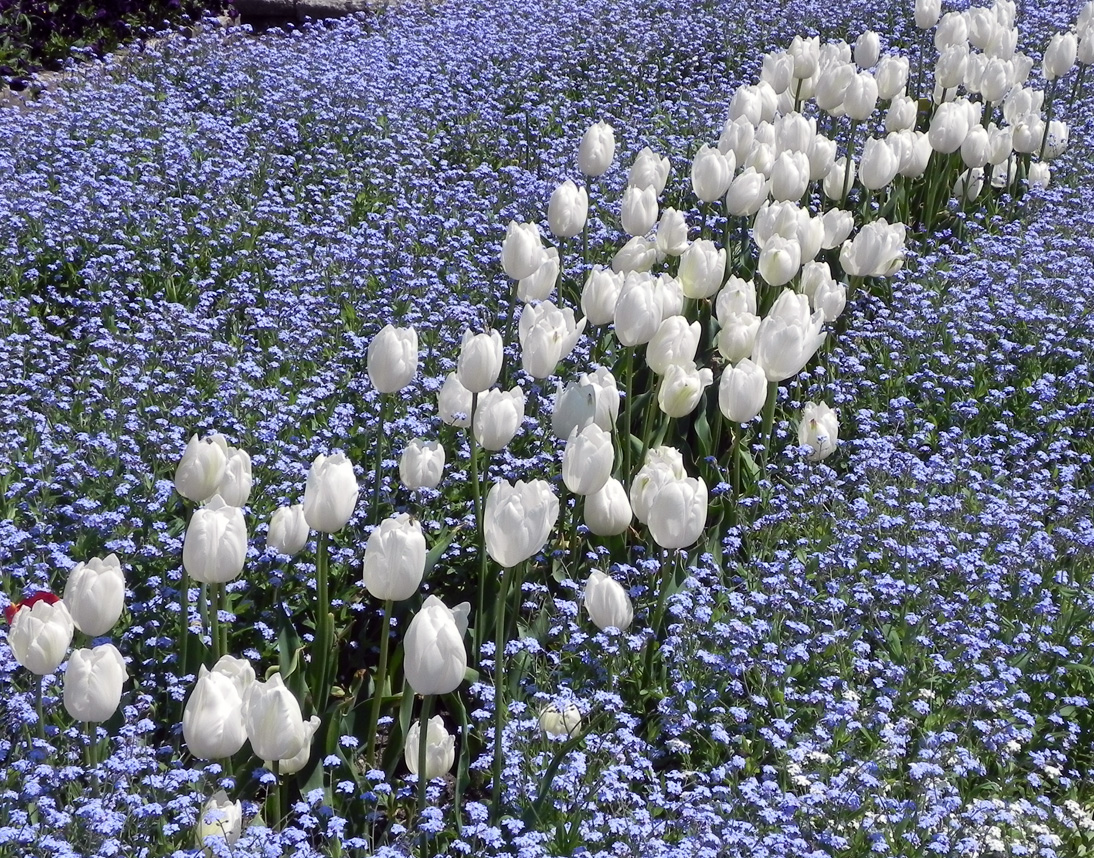
A private garden in Rila; more Tulips!

A sheep herd in Rila
(i.e., sheep literally being herded along)

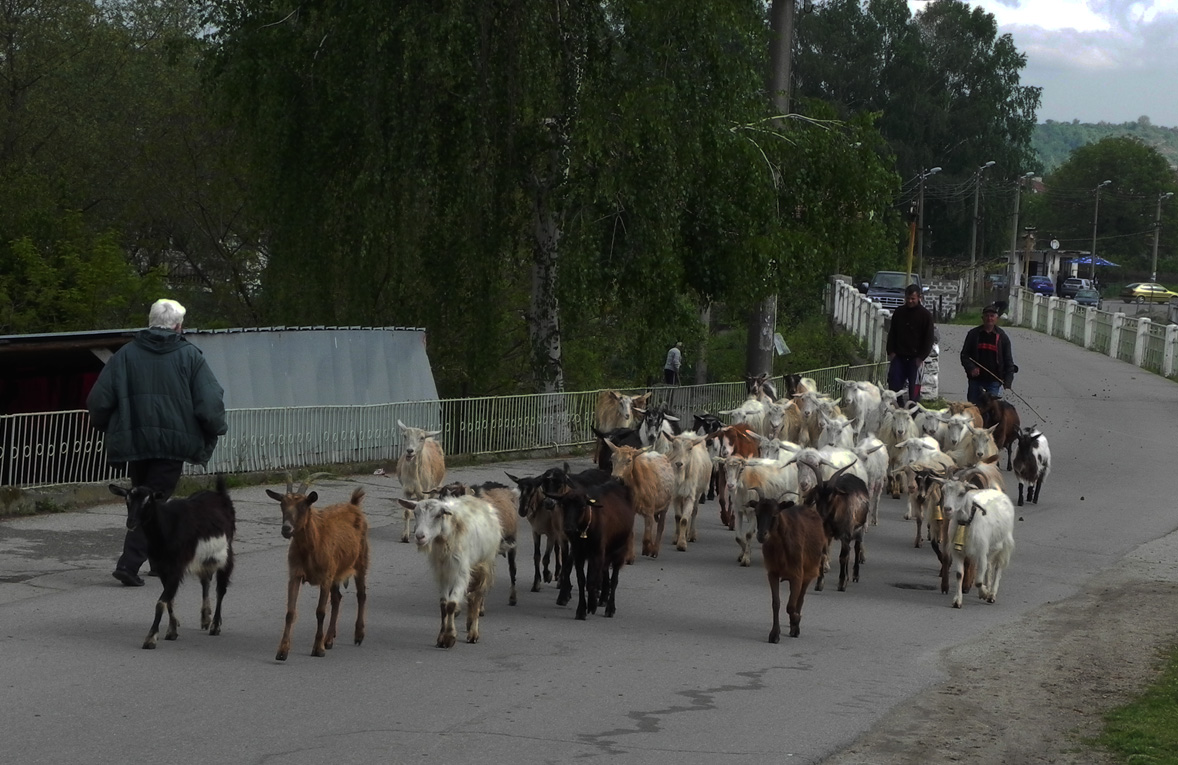
A goat herd in Rila

From the balcony of the suite we stayed in in Rila,
in a sort of private hotel belonging to a clothing designer
and manufacturer (and patron of the arts)

To the left of the photo above; the wooden structure
is a platform hanging over the river that runs
alongside the clothing factory and private hotel

My son photographed me standing on the platform;
I'm wearing the cap my wife bought me in Nessebar

My traveling companions to Rila and Blagoevgrad

To the right of the first photo of the garden below
our suite; we were too low, and the garden was too big
to capture in a single photograph


The side of the private hotel
and part of the garden from the ground
(possibly from the platform over the river; I can't remember)

The American University in Bulgaria, in Blagoevgrad;
 our son and daughter-in-law founded and sustain its
arts program; she plays solo harp for its commencements,
as she did most recently on May 15

The American University in Bulgaria, another view of
its main building, which belonged to the Communist Party
prior to the dissolution of the Soviet Union
(the dog is asleep, not dead)

I would like to have taken many more photographs of our grandson, but I failed to plan ahead and carry along another battery for my wife's camera. I got one fairly good photo of him during our first visit, but the camera was being recharged each time after that.
    We were sorry to have to leave Bulgaria and return home so soon. What a lovely country, what striking contrasts of modern and ancient!

Saturday, June 11, 2011

[Other] animals' rights

I don't write many letters to editors. Or, if I do, I don't send them, but publish them here. The one I just wrote to the editor of the Durham Herald-Sun, I did send. It went like this:
High marks to Joe Moran for the additional restrictions he suggests for honoring and protecting the sacredness of life.
Background before I continue. Mr. Moran's letter, titled "Women's rights," appeared this morning, on p. A6. He was writing about state legislators who "were said to have 'wrestled with deep philosophical and political differences before coming up with new restrictions on women seeking abortions' (New abortion rules for N.C., June 9)."
    You know, restrictions like having the women view a film of an abortion, listen to the heartbeat of their fetus, that sort of thing.
    Mr. Moran continued:
If the issue is truly the sacredness of life, I suggest that similar restrictions...should also apply...in the following instances:
    1) For judges and law enforcement officers, prior to executing a person
    2) For intelligence and military officers prior to dropping guided missiles or bombs from Air Force drones [sic] on homes where there are also innocent people....
My own letter continued:
But Mr. Moran could and should have gone further. Appropriate information would also be useful in the following instances:
    1) For people hired to work at Chik-fil-A, McDonald's, KFC, Smithfield's, etc., tell them how intelligent (and capable of suffering) are the animals whose flesh they'll be required to cook and serve, and show them how those animals are inhumanely raised and slaughtered, some of them still conscious when they're being skinned and dismembered.
    2) For diners before they're served their hamburger, steak, barbecue, or fried chicken, the same.
    That is, Mr. Moran might have given a nod to the rights of animals as well. Or, to be more accurate, the rights of animals other than human ones.
    Suggested reading: Jonathan Safran Foer's 2009 book, Eating Animals, which is this summer's assigned reading for entering freshmen at Carolina and Duke.*
There, I feel better already. Or is it worse, for having thought about the suffering of other animals one more time?
_______________
* June 14: My letter, under the title "Consider animal rights, too" (and above the signature, Morris Dean, Mebane), was published in this morning's Herald-Sun, though without the editor's identifying when Mr. Moran's letter was published or which article he was commenting on.

Friday, June 10, 2011

Beatings will continue

Beatings will continue
until morale improves
I heard a good one yesterday: The theology of the Old Testament, like a cartoon, can be accurately captioned as the corporate dictum: "Beatings will continue until morale improves."
    I "heard" this from Bart D. Ehrman's 2008 book, which I'm currently reading, God's Problem: How the Bible Fails to Answer Our Most Important Question—Why We Suffer. He's surveying the so-called "major" and "minor" prophets of the Old Testament (the designations mean nothing more than the relative word counts of their prophetic books) to show how they tried to explain why the God of the ancient Israelites was treating them so horribly. That is, it was the prophets' answer to that "most important question."
    By the way, it's because the Bible fails to answer the question to Ehrman's satisfaction that he recanted his devout Christian faith and became an agnostic. He went to Moody Bible College in his teens, then to evangelical Wheaton College, and on to Princeton Theological Seminary, where he decided to become a Biblical scholar. He's now at the University of North Carolina at Chapel Hill.
    Ehrman points out that those "prophecies" applied only to the times in which they were written, and to the people to whom they were written, so the jehovahs (as I familiarly term Jehovah's Witnesses), and everyone else, for that matter, have no basis for claiming that the Bible foretells what is happening today.
    Nevertheless, "the beatings will continue" made me think of the Holocaust. The Jews took quite a beating from the Nazis (and from many hypocrites around the world who silently approved the Nazis' attitude and actions to kill Jews). Is the Jews' God still trying to improve their morale by helping Muslim jihadists to wipe Israel off the map?

Of course not. But this does raise the question in my mind whether there might be something else going on to explain why the Jews have been persecuted continually down through the ages (besides their having been tagged Christ-killers, which I don't think explains why the Muslims hate them so much).
    It occurred to me to wonder whether it might be the fact that they invented monotheism? (Some credit Moses with the invention.)
    Sure, orthodox Christians and Muslims are proud to believe in the "one, true God," but consider that they might be proud only in the part of their mind that they're conscious of. A twentieth-century Jew by the name of Sigmund Freud taught us that our unconscious can be quite out of step with our conscious.
    The unconscious of a devout believer can have as many misgivings about a God who allows us to suffer (and may even cause us to suffer, to punish us or try to get us to shape up) as the conscious mind of Bart D. Ehrman can.
    What if even devout believers, in their unconscious, are sick at heart that they even believe in God in the first place? Might they not seek a scapegoat on whom to unleash their anger and otherwise self-disgust (all the while preserving their conscious belief, in which they're too invested to join Ehrman in recanting)?

An amusing conjecture, at any rate.

Thursday, June 9, 2011

Vacation travelogues aren't my thing

Bulgaria Road Map
(click to enlarge)
My wife and I visited Bulgaria last month and I committed myself to providing photographic documentation of the trip (in a brief post featuring our lunch on the Black Sea).
    I apologize for the delay and any disappointment it may have caused you. But the sword hanging over my head has adversely affected me more than the delay has affected you. Every time (but two) that I've had the impulse to blog about something more congenial to myself than doing a trip report, I've suppressed it.
    The first exception led to a post dated May 22 ("Not to be completely mistaken") that I wouldn't have published in the first place if I hadn't been weak and delirious from having contracted whatever bug had traveled home with my wife. I took that ironically named post down a few days later, when I was capable of perceiving its delusiveness. The second was yesterday's, when I'd finally had enough and said the hell with it.

Not only had I contracted some bug or other (which may not have been a Bulgarian exclusive, given that I've talked to several people here who had also been sick, with similar symptoms—sore throat at first, sinus congestion five or six days later), but I was tired as usual from long-distance travel.
    And I was tired especially from the stress of being chauffeured at high speed on Bulgarian roads, seriously fearing impairment or death every time we came up close enough to a slower vehicle ahead of us to touch if we'd reached our hand out before we swerved left and rushed past the hapless vehicle, whose driver was probably wondering "What the hell!" even before we swerved back in ahead of it.
    Somehow, I couldn't relax entertaining the bloody image of being laid up in a hospital in some small town in Eastern Europe, or thinking of my mortal remains' being shipped back to the United States (my cremation insurance doesn't apply elsewhere).
    I was also set back by the daunting task of selecting and editing the large number of photographs from the trip (not to mention having to deal with my office in-box, overflowing with an unusually high number of transactions that had arrived while I was gone for more than a week and a half from my 40-hour-a-week job).
    Only last Saturday did I finally finish renaming the last few scores of photos and begin to re-size and select a few of the ones I might use. I was too tired and annoyed by the whole thing to publish anything Saturday or Sunday, then everyday life caught up with me again and here it is Wednesday (no, Thursday—I wrote the above yesterday). On Tuesday, I had decided, why couldn't I do a partial report, using a few of the photos I did re-size? Okay, sounded good.

I'm not going to attempt a running account to accompany the photos, but be content to provide a short caption for each (as I hope you will be content with the result).
    Travelogues aren't my thing. I didn't know what road we were on most of time, being focused as I was on trying to compose my thoughts before dying. I didn't take notes about this thing or that, or write down descriptions or impressions it might have made on me. I just took a photograph from time to time.
    I confess, travel itself is as little my thing as writing it up is. Leave me at home with my wife and Siegfried, and I'm content. If I want to know something about a place, I'll read someone else's account of it, especially (in the case of Bulgaria) the blog of an American musician there, which contributed to my wife's planning our trip.  The blog's January 10 post, "On the March: Keep Weapons Holstered," with its photograph of a park fence fashioned out of rifles, led to our visiting Sofia's Military Academy park with our grandson, who told us that the rifles had been used in the 1885 War of Bulgarian Reunification.
    I trust that the blog's role in motivating my wife to visit Bulgaria and take me with her isn't the reason our son hasn't posted anything to it after the day he learned that she had purchased our Lufthansa tickets.

All of the photos were made with my wife's Nikon Coolpix P-100. We left my heavier DSLR at home. (Times of the clock shown in some of the photos are according to Eastern Standard Time, seven hours earlier than local time; sorry I forgot to reset the camera. In fact, I hadn't noticed that the camera even put dates and times on its photographs. I might have been able to turn that feature off; I'll have to check this out.)
 
A Shop Salad, or salad in the style of the Shopska region
around Sofia (I ate many salads like this in
my nine days in Bulgaria, perhaps my favorite dish)

A private garden in the village of German
(pronounced with a hard g, as in "gerbil"),
near Sofia

A street in Shumen, which we visited on our way to Varna

In Shumen, we listened to two or three of the competing
violinists as they practiced with their piano accompanist

The small, family-run hotel we stayed in near Varna,
about a quarter-mile from the Black Sea


A donkey cart in a small town on the way from
Varna to Balchik (note the wooden wheels)

My ticket to the University Botanical Garden in Balchik

A poster map of the University Botanical Garden in Balchik

Hats off to the university
for this poster
(despite its English, reminiscent
of instructions for a Japanese
Mickey Mouse watch)

We saw many balls of mistletoe like this along the Black Sea;
these we spotted in the University Botanical Garden

Flower beds in the University Botanical Garden,
looking toward the Black Sea

The flower beds from the Black Sea

Tulips in the University Botanical Garden

More Tulips
(I took many more photos of them than I'm posting here)

A lizard our son spotted in the cactus garden

Front entrance of Restaurant Corona, where we had lunch

A poster describing Restaurant Corona
(or Crown Restaurant)

Down to Queen Marie's garden

A waterfall in the University Botanical Garden

A pregnant cat we came across in Queen Marie's garden

My wife squealed with delight
when she came upon this whimsy
in Queen Marie's garden

View from Queen Marie's palace

A Red Bud tree in Queen Marie's garden,
looking down from her palace

Another Red Bud tree
(or was it the same one?)

The Restaurant Corona from Queen Marie's palace
(brightened, near the center)

Religious icons and other objects
on sale near Queen Marie's Palace
(opportunities to buy icons
abound in Bulgaria)

A commercial icon as well
(read the small print in the image to the right);
our waiter let us take the glass home with us
The sequel is available under the title "Bulgaria travelogue concluded."

Wednesday, June 8, 2011

1.5 Earths already

Paul Gilding, photo for 2010
Spirituality, Leadership, &
Management conference
A few weeks ago ("Feeding animals to the masses"), I cited a study that concluded we'd need five planet Earths if everyone on earth consumed like an American.
    Well, in his op-ed piece in today's The New York Times, "The Earth Is Full," Thomas L. Friedman, citing a study by Paul Gilding, says that we're already "using about 1.5 Earths." That is, "we are currently growing at a rate that is using up the Earth’s resources far faster than they can be sustainably replenished."
    Says Friedman for emphasis: