Welcome statement


Parting Words from Moristotle” (07/31/2023) tells how to access our
archives of art, poems, stories, serials, interviews, travelogues….

Saturday, January 7, 2012

Sunsets & moon risen

January 5, 5:38 p.m., from back yard in Mebane, North Carolina
 
About half an hour after sunset, actually

January 7, 5:04 p.m.
 

5:28 p.m., from front porch
 
Click to check out the edges
_______________
All photos were taken with a Nikon Coolpix P300. The sunsets were hand-held; the Moon was digiscoped with a Nikon ED50 field scope (mounted on a tripod, of course).

Friday, January 6, 2012

Sentients rights

About 225 years ago, Enlightenment philosopher Immanuel Kant (1724-1804) formulated a "categorical imperative," one version of which was that we "act in such a way that you treat humanity, whether in your own person or in the person of any other, never merely as a means to an end, but always at the same time as an end." [Groundwork of the Metaphysic of Morals]
    Yet another way of stating it is that we should respect the right of persons to be treated as ends in themselves (as existing for their own sake).

Recent reading encourages me to consider whether a unified statement of rights for both human animals and other animals might be useful.
    An article in the January 2 New York Times, "Animal Studies Cross Campus to Lecture Hall," reports that the Animals & Society Institute lists "more than 100 courses in American colleges and universities that fit under the broad banner of animal studies." Five of the courses are offered by three universities in the state where I live. Three of the courses are offered at Duke University in the area of women's studies, and two courses are offered, one at East Carolina University and another at North Carolina State University, in philosophy. The description of ECU's course, "Ethics and Animals," explicitly states the connection:
The primary goal of the course is to learn more about ethics or morality from considering the significance of animals in moral deliberation. In thinking about whether animals have rights, for example, we shall also need to ask wider questions such as, what are rights and how do they fit into the system of morality?.... [emphasis mine]
    I had realized in November, when attempting to lay the foundation for my own statement of animal rights, that the existence of any rights depends on prior agreements that have the force of law. And "any rights" includes those of humans, who even quite recently were held in slavery in many parts of the world and, if they are women, are still held virtually in slavery in many places. That is, the existence of human rights, too, depends on prior agreements that have the force of law.
    The Animals & Society Institute also states explicitly the connection between humans and other animals. The Institute's announced objectives are "to promote new and stricter animal protection laws, stop the cycle of violence between animal cruelty and human abuse, and learn more about our complex relationship with animals," and its website home page flatly asserts that there is a link between cruelty toward animals and violence toward humans.
    Agreements about both human and animal rights are becoming more enlightened.

A poignant case for animal rights is given by Steven Pinker in his most recent book, The Better Angels of Our Nature: Why Violence Has Declined:
Let me tell you about the worst thing I have ever done. In 1975, as a twenty-year-old sophomore, I got a summer job as a research assistant in an animal behavior lab. One evening the professor gave me an assignment. Among the rats in the lab was a runt that could not participate in the ongoing studies, so he wanted to use it to try out a new experiment. The first step was to train the rat in what was called a temporal avoidance conditioning procedure. The floor of a Skinner box was hooked up to a shock generator, and a timer that would shock the animal every six seconds unless it pressed a lever, which would give it a ten-second reprieve. Rats catch on quickly and press the lever every eight or nine seconds, postponing the shock indefinitely. [If this was well known, I wonder what the professor hoped to learn by subjecting yet another rat to the procedure.] All I had to do was throw [throw?] the rat in a box, start the timers, and go home for the night. When I arrived back at the lab early the next morning, I would find a fully conditioned rat. [Again, if he knew what he would find...?]
    But that was not what looked back at me when I opened the box in the morning. The rat had a grotesque crook in its spine and was shivering uncontrollably. Within a few seconds, it jumped with a start. It was nowhere near the lever. I realized that the rat had not learned to press the lever and had spent the night being shocked every six seconds. When I reached in to rescue it, I found it cold to the touch. I rushed it to the veterinarian two floors down, but it was too late, and the rat died an hour later. I had tortured an animal to death. [pp. 454-455]
    The episode is for me even more poignant (if that is possible) because I remember that when my wife and I collected seven-week old "Dark Cream Boy" (whom we renamed Siegfried), we were told that he had been "the runt of the litter." Had he been neglected because of it, perhaps ill-treated? Certain of Siegfried's behavioral characteristics suggest that he might have been.
    Pinker admits that as the experiment was being explained to him, "I had already sensed it was wrong."
Even if the procedure had gone perfectly, the rat would have spent twelve hours in constant anxiety, and I had enough experience to know that laboratory procedures don't always go perfectly. My professor was a radical behaviorist, for whom the question "What is it like to be a rat?" was simply incoherent. But I was not, and there was no doubt in my mind that a rat could feel pain. [emphasis mine] The professor wanted me in his lab; I knew that if I refused, nothing bad would happen. But I carried out the procedure anyway, reassured by the ethically spurious but psychologically reassuring principle that it was standard practice. [emphasis mine; p. 455]
    Pinker writes that he included the anecdote "to show what was standard practice in the treatment of animals at the time." And he summarizes even worse practices before stating:
I'm relieved to say that just five years later, indifference to the welfare of animals among scientists had become unthinkable, indeed illegal....[emphasis mine]
    Any scientist will also confirm that attitudes among scientists themselves have changed. Recent surveys have shown that animal researchers, virtually without exception, believe that laboratory animals feel pain. [emphasis mine] Today a scientist who was indifferent to the welfare of laboratory animals would be treated by his or her peers with contempt.
    The change in the treatment of laboratory animals is part of yet another rights revolution: the growing conviction that animals should not be subjected to unjustifiable pain, injury, and death....[emphasis mine; pp. 455-456]
    To say that agreements about rights are becoming more enlightened is equivalent to saying that standard practice is becoming more enlightened.

Richard Dawkins was quoted in the Times on September 19 (in the article "A Knack for Bashing Orthodoxy"):
"Consciousness has to be there, hasn’t it?...It’s an evolved, emergent quality of brains. It’s very likely that most mammals have consciousness, and probably birds, too."
    (He has embraced the Princeton University philosopher Peter Singer’s Great Ape Project, which would accord legal rights to apes, including a prohibition against torture.)
    When I invoked the comparison with human slavery above, I hadn't yet seen the first paragraph of Singer's paper explaining "why the [Great Ape] project":
Aristotle refers to human slaves as "animated property." The phrase exactly describes the current status of nonhuman animals. Human slavery therefore presents an enlightening parallel to this situation. [emphasis mine] We shall explore this parallel in order to single out a past response to human slavery that may suggest a suitable way of responding to present-day animal slavery.
So, what to call rights respecting both humans and other conscience beings? Something, perhaps, that identifies Dawkins's essential, common "emergent quality of brains" The terms consciousness and sentience are obvious possibilities, each of which has a paired term: conscious beings and sentient beings. The latter can also be rendered sentients; there doesn't seem to be such a term for the former.
    And Wikipedia's entry on sentience seems to establish a precedent for the use of that term in this context:
...The concept is central to the philosophy of animal rights, because sentience is necessary for the ability to suffer, which entails certain rights. In science fiction, non-human characters described as "sentient" typically have similar abilities, qualities, and rights as human beings.
Sentients rights, therefore, let it be. And can we update Kant accordingly?
Act in such a way that you treat sentients, whether in your own person or in the person of any other sentient, never merely as a means to an end, but always at the same time as an end.
    Yes, but only if we reach agreements to do so and write them into law. Notice that these agreements would need to address the eating of animals.
_______________
I might well have mentioned Sam Harris along with Pinker, Dawkins, and Singer. I quoted him on animal rights last April.

Thursday, January 5, 2012

Motomynd unmasked (mostly)

When I first published Motomynd, I identified him as a "mystery friend." Since then, by dint of diligent detection, I've learned a few things:
    By googling back in November, I came across a website named "Motomynd" (and I actually announced the find that month).
    Then, just this morning, I happened to be fooling around with the Contacts in my new cell phone, and I noticed that the phone number I'd put there for Paul's Eclectic World (one of the Daniel Boone Traders in Hillsborough) is the number given on the Motomynd site (919-370-0413).

My wife and I had visited Paul's Eclectic World a month or so ago, and I even bought some wonderful decorative stones made in Africa—tiny rounds that could serve as coasters if only they were wider and absorbent. The proprietor, who said he was the very Paul, gave me a discount. I had mentioned my blog to him, so did he recognize me as Moristotle, but coyly decline to acknowledge that he was Motomynd? Mystery Man indeed—with an interesting sense of humor. (Or is he perhaps some sort of borderline recluse? That's yet another mystery....)

Having discovered that connection, and with Sherlock Holmes juices now flowing, I did some googling this morning and found the same telephone number for a photographer's website, "Photo Active Inc," and an obviously related website called "Model Mayhem."
    I say obviously. The proprietor of Model Mahem identifies himself at the top as "Photo Active Inc," which is indicated as doing business in North Carolina, Virginia, and the District of Columbia. The lead paragraph cinches it:
Thank you for stopping by. I am a career editorial/event photographer and writer with credits in more than 400 publications around the world. In 2012 I am launching a motorcycle website [emphasis mine] devoted to touring and road-course racing, and am looking for models—male and female—who actually ride or who are at least comfortable handling a bike. I am also expanding my fashion niche in lifestyle, fitness fashion and swimwear photography.
    No recluse here, so scratch that conjecture. But "interesting sense of humor" is still in the running.
    Elementary, Watson?

But who is this "editorial/event photographer" (and what is an "editorial photographer")? His first name, we will assume, is Paul. But what is his last name? Judging from what he has written so far (on Moristotle and on his presumably own websites), I am unlikely to be successful if I return to Paul's Eclectic World with the intention of beating it out of him. I'd be more likely to have my ass handed back to me.
    But maybe not. He was, after all, willing to donate the biker photo when I called to ask him for one this morning. (He's very prompt; add that to the mix of evidence.)
    And whoever answered the phone did sound like Paul of Eclectic World....

Monday, January 2, 2012

Oz man: thus*

We planted two new Osmanthus bushes recently along the southeastern side of our garage, and they are delightful in their evergreen leaves and subtly fragrant blossoms.

Osmanthus
_______________
* Mnemonic device: Frank Morgan (1890-1949) was the cinematic Oz Man. He played the title role in the 1939 film, The Wizard of Oz.

Saturday, December 31, 2011

Innocent bystander

Sitting still yesterday for the woodpecker to return (he didn't), I noticed a number of much smaller birds among the tangles of branches, including this lovely House Finch:


The focus isn't perfect. The range is quite shallow with the fieldscope, and I'm wondering whether it's better to set the focus a bit on the far side or a bit on the near side? I plan to test this on my next outing; a bird won't even need to be in view. I could even tack up an optometrist's chart a hundred feet away.

Or just focus on a detail of a tree? Here's a photograph of the woodpecker's suspected nest (taken with a Nikon D60, using its 55-200 mm lens):

Note the two big holes in the center of the photo

But perhaps the fieldscope focus was fine and the strong wind blurred the image a bit (relative to shutter speed)? The three photos of the Finch were taken in just a few seconds, and you can see the different positions of the surrounding twigs and tendrils.

Friday, December 30, 2011

Peck on wood

I used a different strategy today (from my last outing—not reported here—when I moved my setup several times trying without success to get a photograph of the elusive woodpecker, who moved from one spot to another so quickly I couldn't react in time). This time I set up my digiscoping equipment and sat down in an unfolding chair to wait patiently until a woodpecker might show up.

First photo

Second photo, taken seconds later;
the last I saw him for today

    My setup consisted of a Nikon ED50 fieldscope, a Nikon camera attachment FSB-U1, and a Nikon Coolpix P300 camera. It was about ninety feet from the tree, and the woodpecker was about fifty feet up.

Thanks to my wife for some identification:
The woodpecker is a juvenile red-headed woodpecker, a threatened species. When I first saw the bird some months ago, I thought it was a juvenile red-head but I couldn't be sure until I saw these photos. A mature red-headed woodpecker doesn't have the black bars among the white feathers, and the head is even redder. Notice how this guy has some black showing in his red head. Check out the photos on this Red-Headed Wookpeckers page for comparison.

Thursday, December 29, 2011

Haircut

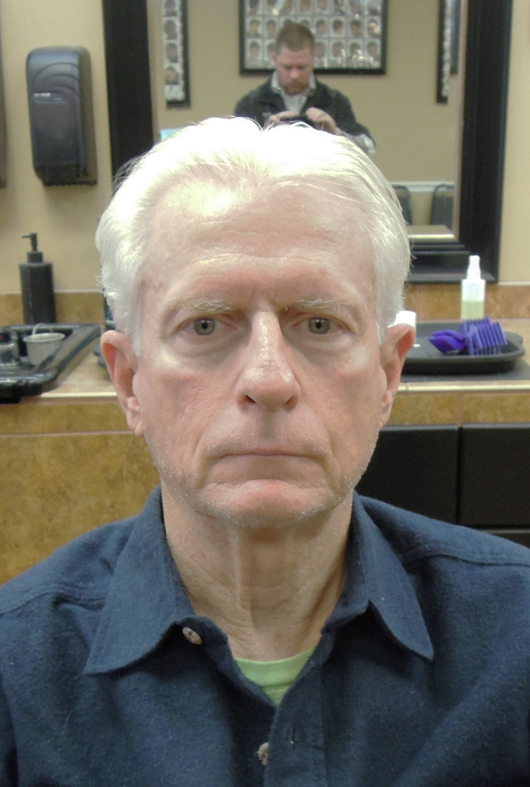
For about a year I've had my hair cut by students at the Beyond Measure Barbering Institute in Mebane. Today, my barber took photos before and after the job. (Click each photo to get a closer look.)

Before (Jeff in the mirror)

After

Before

After

Before

After (the hair isn't  darker in the middle—just longer;
growing from the depression left by 1996 brain surgery)

Jeff told me that he'll graduate in about a month, already has a job lined up in a friend's shop in Burlington.
    We got to discussing the barbering trade, disinfecting the instruments, disposing of blades. I said it was like medical waste; did he know that several hundred years ago, barbers were—
    "Surgeons," Jeff said. "Chapter One of the textbook covers the history of barbering. We study anatomy too."
    And to think I had thought that the Institute was just about cutting techniques.
    "Mr. Long requires that we submit a complete business plan also, before we can graduate. Ready to present to a bank."
    I knew that my neighbor (Mr. Long) was a dedicated and competent businessman, but I hadn't known much about his business (other than the practically important part that his students' haircuts are a fine bargain at five dollars).
    On the way out of the shop, I asked him if I could borrow a copy of the textbook.
    "I'll drop it by your house," he said.

New day's resolution: S-p-R

Moristotle, you recently said that you'd be more mindful how you spend your time. Are you spending it better?
    If you'd asked me that yesterday, I don't think I could have answered coherently—and not sure I can yet. Apparently, the challenge to be more mindful went deeper than I realized. It raises lots of difficult questions.
    For example?
    Well, first, I got off on questions of how humans in general could make better use of their time. Thinking about "obvious truths" such as that people ought to choose to eat healthier foods (when such choices are available to them) made me realize that I have virtually zero influence over other people's choices. As I said the other day, who's going to enforce them? And on what basis? Maybe it would be "better" overall for some people to eat as unhealthily as they possibly can—so that they'd die sooner and overpopulated Earth could get on with recycling their bodies.
    That sort of thinking would be a distraction.
    Indeed. My "new ten commandments" (or Christopher Hitchens's or George Carlin's, or anyone else's—except perhaps God's, if some new "God" should come along and bring Scripture up-to-date) will make next to no difference whatsoever.
    How could an update from "God" be an exception?
    Simply that millions of people believe that commandments that enjoy "God's" endorsement deserve fealty, even when they contradict clearly superior ethical principles.

Ah, so it really comes down to what "better" means? And maybe that comes down to each individual's having to decide for him or herself—at least in a more or less free society, if not in places like North Korea, where the State decides for you, or in an Islamic theocracy, where the local mullah tells you what to do?
    Right. Just yesterday did I finally come around to the realization that perhaps the main way I could spend my time better would be to stop thinking (and writing) about how other people could better spend theirs. They're going to spend it how they will. Even principles with "God's" endorsement for how people spend their time won't cut it with someone who won't buy into them.

So, what did you do this morning to spend your time better on a strictly personal level?
    I took a book to the restroom after breakfast rather than a Sudoku puzzle. Doing Sudokus is absorbing (and may even have health benefits in terms of "sharpening the brain"), but I'm sure I get more out of serious book reading.
    As simple as that?
    Yes, quite. Simple might be the operative word. Another distraction I was having besides thinking about how people in general could better spend their time was the fact that some questions run so deep they could overturn my life—like, Why not live somewhere else? Why not find new friends? We need to let some things lie. At any rate, we can't reasonably make huge changes all at once, unless we're in a very dangerous situation and need to extract ourselves from it at once. Someone I know recently fled a man who had been beating her and she thought might be planning to kill her.

Okay. So, what else did you do this morning?
    Well, something I've actually been doing for several days—"pencil push-ups" that my neuro-ophthalmologist mentioned again recently for strengthening my eye muscles for reading. (I do thirty reps of following the eraser on a pencil as I move it to and from my eyes.) I'd neglected this exercise of late, but became mindful that perhaps I should be doing them. Also, I stretched before even getting out of bed. I got myself more fully awake before stumbling into the kitchen, if only in order to be more self-aware of what I was doing so that I could do it more efficiently—and maybe even enjoy it more. (I think I did.) And when I was turning on my computer to do my "daily" blog (this is the first one since Sunday), I got out my new cell phone to finish ripping an audiobook to it. And while I was waiting for the computer to be ready to rip, I started updating my contacts...It actually started to seem ridiculous. I was afraid I would forget some of what I wanted to say in this web log.

So, even just "doing the simple things" can get pretty involved?
    Indeed! It made me realize that trying to make better use of my time can get me off into yet another distraction—the idea that there's an absolutely best thing to do, right now. That kind of thinking tends to paralyze me, throw me into confusion.
    So, have you found something solid now that you can more or less rely on?
    I think so. Actually, it's something from more than half a lifetime ago, some advice I heard from a traveling lecturer. Simply to pause before responding to stimuli (of my own choosing) in order to think of alternatives and inject a bit of "free choice" as to what my response will be. Stimulus-pause-Response.
    Why did you put air quotes around "free will"?
    Are you sure your will is actually free?
    Ah, right. I see what you mean...Anyway, may we call the pause-before-responding maxim a "new day's resolution"?
    Sure, why not? You know how I dislike holidays.

Sunday, December 25, 2011

Bright, warm, cheerful, loving

Gifts were exchanged, photos were taken, pie was eaten, cheer abounded.

My wife's gift tree

Pecan pie (no chocolate, no bourbon, and no
whipped cream yet)

Vera Bradley tray

Matching Vera Bradley ornament box


Vera Bradley ornament on display

L.L. Bean gift bag (pancake mix & maple syrup)

See's candy trove (didn't include crystal)

One of three Philip Kerr thrillers
(featuring Bernie Gunther)

Backpack for SLR and accessories (including tripod)

Pecan pie with whipped cream

First two of four pieces cut (for two overeating humans)

Gift array (1)

Gift array (2)

Gift array (3)

And Siegfried was ever photogenic.


"Let's go for a walk!"

And a dove, so peaceful and quiet.

Saturday, December 24, 2011

Killer instinct

Yesterday was the morning after. The night before, I had watched Part 2 of the 2008 French film pair, Mesrine: Killer Instinct and Mesrine: Public Enemy #1, starring Vincent Cassel as the "most famous criminal in modern French history" (Wikipedia). Cassel was in last year's Black Swan, opposite Natalie Portman, who, interestingly in the current connection, debuted in the 1994 French film, Leon: The Professional [assassin].
    My wife stopped watching about half-way through, a little after I'd almost stopped myself. But even after she went to bed, I remained to watch, to the bitter end. Why did I do that? I "officially" rated Part 1 (which we had watched the night before) F[air] and Part 2 P[oor], but I'm not sure they are that bad (although Part 1 is a better-made film than Part 2, which was shoddily edited and tediously repetitious—my wife later commented that the additional depictions of Mesrine's bank robberies, prison escapes, and kidnappings provided "no new information").

I might have downgraded both ratings because of a recent challenge from a friend, who doesn't find anything positive in movies about such people, who he thinks should be exterminated rather than glorified in film. He said that films like Francis Ford Coppola's The Godfather and TV programs like The Sopranos desensitize us toward evil. He hasn't seen either of these, and he wondered why I watched them (The Godfather and its two sequels at least twice each).
    I plead a fascination with story, and I'm especially fascinated by a true one.
Bonnie & Clyde in March 1933;
photo found at their hideout
    Because of his caution about the corrupting influence of depictions of evil people, I did watch the Mesrine films a good deal more thoughtfully than usual: I more closely watched myself watching. I was glad to find myself clear on the point that Jacques Mesrine—even with all his (or was it Cassel's?) charm and evident intelligence—was no one to imitate (the French likened him and one of his female associates to Clyde Barrow & Bonnie Parker).

I should disclose that I didn't know that Mesrine (pronounced may-reen) was a real person until I looked the movies up on the Internet Movie Database. I think I would have been less inclined to stop watching Part 2 if I already knew that, just to see how it actually (as opposed to fictionally) turned out.
    Yes, it was a true story and, as my friend recommended, after Mesrine's several incarcerations in MSPs (maximum security prisons), from all of which he had escaped, the French police decided they had no choice but to exterminate Mesrine. The photo at the top is the final shot of Cassel as Mesrine slumped over thoroughly dead behind the wheel of his car, having been shot by several officers firing down on his windshield with rifles from a truck that had managed to position itself immediately in front of Mesrine at a stop light.
    Not knowing beforehand that Mesrine was real sharpens the question: Why was I watching? Such stories are the stuff (when well produced) of strong dramatic cinema (or TV), same as Oedipus Rex, with its patricide and oedipal sex and self-mutilation, was strong dramatic theater to the Athenians, or Macbeth, with all its carnage, to the Elizabethans. I plead a fascination with story, not any glorification or worship of characters portrayed.

Plato (424/423-348/347 BC)
Movies & TV dramas present the irony that even though people usually identify with certain of their characters and enter into the story in their imagination, they usually don't map the world of a story to the reality of their own lives. Or at least I don't. I tend to objectify story worlds and analyze them in terms of plot, theme, dramatic arc, etc., as well as of writing, acting, directing, editing. I watch as an amateur film connoisseur.
    My sense of the Mesrine films is that their producers had not set out to glorify or worship the bad guys depicted. But does that matter? Might not people who cut other people up with a chainsaw have gotten the idea from Brian De Palma's 1983 gangster film, Scarface? What if we knew that that's precisely where one such person got the idea? Should Scarface therefore not have been made? In Book X of Plato's Republic, poets are banished in order to protect the populous from indulging base emotions, if vicariously, and transferring them to their own lives, where the emotions can transform them into the characters they saw on stage.
Aristotle (384–322 BC)
     Plato's student Aristotle looked at differently. Stories about bad guys permit us to examine and deal with our own "dark side." Aristotle held that achieving catharsis was a healthy reason to go out to the theater; it cleanses your emotions.
    But, again, it matters who "your" is. Myself, I don't ordinarily think I need an emotional purging; I don't think The Godfather—and certainly not the Mesrine films—helped me get in touch with my dark side. I know clearly where I stand.
    But I suppose some people, who actually lean toward doing evil and being bad guys (whether they're aware of it or not), can be schooled in evil by such portrayals, perhaps even be taught behaviors to emulate. Most people who have seen Scarface (including me) haven't attacked (and will not attack) other people with a chainsaw. Isn't it okay for those people to watch such films? Just not okay for the few people who do get evil ideas (and are likely to act on them)?
    So, who's going to enforce who watches what, or what films and TV programs are produced (or what books are written or published)?

Only I myself "enforce" what I will watch. My friend's challenge to me is that I be more mindful whether there's a better way for me to spend my time. A better movie to watch, a better TV program? A better activity altogether than watching—Reading? Going for a long walk? Writing a letter?
    My friend was questioning whether it's morally justifiable to watch a movie (and especially a movie about bad guys) because doing so is our habit or our custom or our tradition. I agree that habit/custom/tradition is not a moral justification—for anything. And it's often just the opposite, tradition granting permission to continue to indulge in questionable behavior.

Thursday, December 22, 2011

Business plan

The overbalanced-wheel
perpetual motion machine
Some friends and I were free-wheeling this morning what sort of retirement business we might go into. One of us suggested that we do consulting, in which our core service would be to put clients into a therapeutic trance, during which we would implant suggestions congruent with what we had previously learned of their desires for changing their lives or "succeeding." Our suggestions would generally be of the sort that the next day or the next week a revelation about "what to do" would pop into the client's mind accompanied by a sense of his or her resourcefulness to undertake the revealed action or first step.
    "Ram Dass already did something like that," somebody said.
    "What? He's patented it? Would we have to buy a license?"
    I said I didn't think so, our idea was different. Our marketing plan would feature the guarantee that our service was entirely free if nothing materialized—for whatever reason, even including the client's not having the courage to undertake a revealed action (and of course including the possibility that no action ever got revealed in the first place). We'd get paid only if an action were revealed, the client acted, and the results were beneficial. (We haven't worked out a fee schedule yet.)

It occurred to me later (as something almost always occurs to me when I'm trying to think of something for the day's web log) that the religion business is somewhat similar. People go to church and either are put into a trance or put themselves into a trance and expect good things to happen as a result.
    For most people, something good happens frequently enough that they continue to pay the fee of continuing to go to church and contributing to its upkeep.
    The main difference with the religion business is that the client doesn't have to do anything but pray. When the thing prayed for happens, prayer is confirmed; when it doesn't, it doesn't count—according to the casuistry that "God answers prayer according to his will, not to that of the person praying." Religion thus perpetuates itself.

The blogging business (or the business of dedicated writing in general) is much more like the trance-induction business plan than religion is. Signing on for the writing business, thinking of yourself as a blogger or a short story writer or a novelist, dedicating yourself to it, is an act of auto-suggestion, which, if you're lucky, results in regular "revelations" of things to write about or ways to approach a piece or even (when you're really lucky and tending to imitate Wolfgang Amadeus) what words to write.
    And the result, like the daily web log, is the practitioner's reward, his pay-off. On days when nothing materializes, no pay.
    If reward is paid often or regularly enough, a habit is established, revelations establish expectation, expectation provokes revelation. A perpetual motion machine has been set running.
    A doing-business-as name may have just popped into my mind.

Wednesday, December 21, 2011

North Koreans will keep quiet, or else

The late Kim Jong-il
As you may not have been able to avoid learning, North Korea's "great leader" died Saturday, and his son, "the great successor to the revolution" and "the eminent leader of the military and the people," took over. The king is dead; long live the king, and all that.
    According to Monday's New York Times ("Kim Jong-il, North Korean Dictator, Dies," by Choe Sang-Hun and David E. Sanger):
An enormous funeral service is scheduled for Dec. 28 in Pyongyang, according to K.C.N.A., a state news agency. The following day, a separate “national meeting of mourning” will take place, with all North Koreans instructed to pay a three-minute silent tribute to Mr. Kim. [emphasis mine]
    If you're wondering why they have to be instructed to be quiet, you might find instruction of your own in the following passage from Christopher Hitchens's 2010 memoir, Hitch-22:
I still make sure to go, at least once every year, to a country where things cannot be taken for granted and where there is either too much law and order or too little...One of the articles for Graydon Carter [Vanity Fair] that won me the most praise was an essay titled "Visit to a Small Planet," in which I described acquiring another identity and bribing my way into North Korea. Every time I got a tribute to the success of this piece I felt a slight access of shame, because only I could appreciate what a failure it was. I had exerted all my slack literary muscles to evoke the eerie wretchedness and interstellar frigidity of the place, which is an absolutist despotism where the slaves are no longer even fed regularly (and is thus its own version of the worst of all possible worlds), but I knew with a sick certainty that I had absolutely not managed to convey to my readers anything of how it might feel to be a North Korean even for a day. Erich Fromm might perhaps have managed it: in a place with absolutely no private or personal life, with the incessant worship of a mediocre career-sadist as the only culture, where all citizens are the permanent property of the state, the highest form of pointlessness has been achieved.... [p. 349]
    "Visit to a Small Planet" appeared in the January 2001 issue of Vanity Fair. It is not included in Hitchens's final collection of published essays, Arguably, for it had already been collected, in 2004, in his third collection, Love, Poverty, and War: Journeys and Essays.

Nicholas D. Kristof reports today in The New York Times ("A New Kim. A New Chance?") that when he went to North Korea in 1989, he visited quite a few ordinary North Koreans in their homes:
The most surprising thing I found was The Loudspeaker affixed to a wall in each home. The Loudspeaker is like a radio but without a dial or off switch. In the morning, it awakens the household with propaganda. (In his first golf outing, Comrade Kim Jong-il shoots five holes-in-one!*) It blares like that all day.
    The Loudspeaker underscores that North Korea is not just another dictatorship but, perhaps, the most totalitarian country ever. Stalin and Mao were murderous but low-tech; the Kim family added complex systems of repression.
    Anyone disabled is considered an eyesore, for example. So people with disabilities are often expelled from the capital, Pyongyang.
    Government propaganda is shameless. During a famine, North Korean news media warned starving citizens against overeating by recounting the cautionary tale of a man who ate his fill, and then exploded.
    Once in North Korea, I stopped in a rural area to interview two high school girls at random. They were friendly, if startled. So was I when they started speaking simultaneously and repeating political lines in perfect unison. They could have been robots....
_______________
* December 22. Apparently this refers to an actual announcement. The Christian Science Monitor reports (in "Kim Jong-il: Legendary golfer and mythical powers even in death," by Jean H. Lee) that "The first time he bowled, Kim Jong-il scored a perfect 300, according to North Korean media. Similarly, in his first-ever round of golf, he had five holes-in one for a 38-under-par round."
    I googled but couldn't find any photos of Kim Jong-il playing golf (or bowling). But I did discover that someone has been running the "Kim Jong-Il looking at things" Facebook page.

Tuesday, December 20, 2011

Quote of the day (Paul Krugman)

Paul Krugman's statement, below, from his December 18 New York Times column, "Will China Break?," is striking because he's an economist and even awarded the 2008 Nobel Memorial Prize in Economic Sciences:
All economic statistics are best seen as a peculiarly boring form of science fiction.