Welcome statement


“Parting Words from Moristotle” (07/31/2023) tells how to access our
archives of art, poems, stories, serials, interviews, travelogues….

Thursday, September 30, 2010

Evidence to support the term "bright"?

A phone survey conducted by the Pew Forum on Religion and Public Life was released on Tuesday. Among its findings:
  • Forty-five percent of Catholics did not know that their church teaches that the consecrated bread and wine in holy communion are not merely symbols, but actually become the body and blood of Christ.
  • Forty-three percent of Jews did not know that Maimonides, one of the foremost rabbinical authorities and philosophers, was Jewish.
These findings were reported in The New York Times (September 28), in the article, "Basic Religion Test Stumps Many Americans," by Laurie Goodstein, who led off with the statement that "Americans are by all measures a deeply religious people, but they are also deeply ignorant about religion."

I had somehow missed the news, even though the survey had apparently been very widely reported.
    My friend Ken alerted me by email:
The article contains a memorable observation from the president of American Atheists: “I have heard many times that atheists know more about religion than religious people. Atheism is an effect of that knowledge, not a lack of knowledge. I gave a Bible to my daughter. That’s how you make atheists.”
    Some of the stats in it are jaw-droppers. For example: "53% of Protestants could not identify Martin Luther as the man who started the Protestant Reformation."
    [Given the religious views that predominate in the Western world and the fact that I've met a great many ignorant Christians,] I must conclude that no one is more ignorant about religion than a Christian.
As qualified, Ken's conclusion doesn't seem to be a non sequitur (in the original, logical way that Aristotle and I use the term). Christians, among the groups identified by the study, might indeed be the most ignorant about religion. [Note that as Goodstein's article points out, "There were not enough Muslim, Buddhist, or Hindu respondents to say how those groups ranked."]
    The alleged superiority of atheists' (and agnostics') knowledge of religion might have been involved in philosopher Daniel C. Dennett's suggesting the term "bright" for atheists1, even though he claims that he didn't intend it that way, any more than "gay" for homosexuals is meant to imply that homosexuals are less morose than other people.
_______________
  1. "In Breaking the Spell: Religion as a Natural Phenomenon he admits to being 'a bright,' and defends the term." –Wikipedia

Wednesday, September 22, 2010

Sacrifice is for the little people

"Anger is sweeping America," wrote Paul Krugman in "The Angry Rich" on September 19 in The New York Times. "I'm talking about the rich," he said.
The rage of the rich has been building ever since Mr. Obama took office.
    ...For one thing, craziness has gone mainstream. It’s one thing when a billionaire rants at a dinner event. It’s another when Forbes magazine runs a cover story alleging that the president of the United States is deliberately trying to bring America down as part of his Kenyan, “anticolonialist” agenda, that “the U.S. is being ruled according to the dreams of a Luo tribesman of the 1950s.” When it comes to defending the interests of the rich, it seems, the normal rules of civilized (and rational) discourse no longer apply.
    ...And among the undeniably rich, a belligerent sense of entitlement has taken hold: it’s their money, and they have the right to keep it.
    ...The spectacle of high-income Americans, the world’s luckiest people, wallowing in self-pity and self-righteousness would be funny, except for one thing: they may well get their way. Never mind the $700 billion price tag for extending the high-end tax breaks: virtually all Republicans and some Democrats are rushing to the aid of the oppressed affluent.
    ...You see, the rich are different from you and me: they have more influence. [emphasis mine] It’s partly a matter of campaign contributions, but it’s also a matter of social pressure, since politicians spend a lot of time hanging out with the wealthy. So when the rich face the prospect of paying an extra 3 or 4 percent of their income in taxes, politicians feel their pain — feel it much more acutely, it’s clear, than they feel the pain of families who are losing their jobs, their houses, and their hopes.
    ...And when the tax fight is over, one way or another, you can be sure that the people currently defending the incomes of the elite will go back to demanding cuts in Social Security and aid to the unemployed. America must make hard choices, they’ll say; we all have to be willing to make sacrifices.
    ...But when they say “we,” they mean “you.” Sacrifice is for the little people.
Please pay Mr. Krugman and The New York Times for my long excerpt by taking the link to his article and reading it in its entirety. It provides more examples of attempted manipulation by the rich, as if they didn't practically run everything already anyway.
    And read the letters to The Times in response to the article. For example, Steven Berkowitz wrote the next day:
G. K. Chesterton identified a source deeper than the sense of entitlement to explain the anger of the rich at paying taxes: “The poor have sometimes objected to being governed badly; the rich have always objected to being governed at all.”
Simply let money [continue to] govern?

Tuesday, September 21, 2010

We know that dolphins are really smart

In her article in the Science section of today's New York Times ("Studying the Big-Brained Dolphin"), Claudia Dreyfus interviews psychologist Diana Reiss.
Q. We know that dolphins are highly trainable. But how smart are they, really?
    A. Let me tell you a story. One of the first dolphins I ever worked with was Circe. I’d bring her a fish when I wanted her to do certain things. If she didn’t do them, I did a “time-out” where I turned my back and walked away. Well, there was a certain type of fish that Circe loathed because it had a spiny tail. So I accommodated her by cutting the spines off of the tail. One day, I forgot to do that. Circe spit it out, swam to the other side of the pool and placed herself into a vertical position that mimicked my time-out. I wanted to test this. I gave her untrimmed fish on four different days. Whenever I gave her fish with spiny tails, she gave me a time-out. What that suggested was that she saw time out as a correction and used it back on me. Well, that’s how we learn to communicate.
The article reports that Dr. Reiss advised the producers of the 2009 Oscar-winning documentary, The Cove, which I reviewed on June 16, recommending it as:
must-see for its exposure of the atrocity of Japan's annual deliberate slaughter of thousands of dolphins.
Dreyfus asks Reiss:
Q. How did you get involved with [The Cove]?
    A. I had learned about this fishing village in Japan, Taiji, where dolphins are herded into a small inlet and brutally slaughtered. These animals were being eviscerated and just left there to slowly die, flailing about in the sun. Well, these are the same type of dolphins I work with. I know how sensitive they are, how much pain they can feel, how a mere scratch bothers them.
    Few scientists were speaking out about this. So I got biologists and aquarium professionals together and we started Act for Dolphins. We went to the Japanese Embassy in D. C. to bring them scientific information about the animals. Their attitude basically was, “anything we do in our waters is our business.” I also began working with Louie Psihoyos, the film director, and that was the beginning of making the The Cove. It’s been shown in Japan, but that hasn’t stopped the dolphin drive.

Q. How do some of your fellow scientists feel about your activism?
    A. It used to be that you weren’t supposed to do both. But when I went to a marine-mammal conference a couple of years ago, I brought a petition against the dolphin roundup in Japan. Three hundred scientists instantly signed.
    My feeling is if we can’t stop 34 fishermen from treating these animals so miserably, then what hope is there for fixing anything in this world?
Even if the Japanese businessmen are stopped, there's so much else our hearts cry "stop" to, including acts by our own businessmen.
    But maybe it's like the starfish that the beachcomber threw back into the ocean. A passer-by said, "What difference does it make? There are so many starfish you can't save from dying in the sun."
    The beachcomber replied, "It makes a lot of difference to that one."

Monday, September 13, 2010

Saturday, September 11, 2010

No book burnin' today, but...

Pastor Jones won't be burning any books today. According to The New York Times, he said this morning, "We feel that God is telling us to stop."
    But my final sentence yesterday did set one reader to musing:
Ah, yes, book burning—it has such a distinguished pedigree in western history. I'm sure you've seen old footage showing the Nazi party doing this in Germany—on their way to taking over the country. And, then, of course we have had book burnings in America.
    And in that most Catholic of countries, Portugal, the sure way to quell dissent during hard times in the 17th century was to incite the mobs in Lisbon to look for Protestants or Jews and burn them on a stake for having brought God's anger (evidenced by the hard times) on the country. I guess we can congratulate ourselves that we're only burning books (printed heresies, rather than the heretic).
It provoked a thought in me too, the fantasy that religionists of all stripes come to realize that their only hope for reconciliation is to start from scratch on common ground. After thoughtful deliberation, to avoid the whole unseemly mess of burning each others' books, they strike an unexpected bargain.
    On a mutually agreed and appointed day, they will all burn every last copy of their own holy book. In one quick, concerted action, they will sweep away all official barriers to amity and concord.
    They expect that a good measure of peace on earth will have arrived at last.

Friday, September 10, 2010

Before Darwin, and after

Christopher Hitchens's interesting collection of "essential readings for the non-believer" (published in 2007 under the catchy title, The Portable Atheist) includes an essay by George Eliot (1819-1880) ridiculing the evangelistic career of the Reverend John Cumming (1807-1881)—originally published in 1855, in the Westminster Review.
    It is tonic to realize how energetic the criticism of religion was even before the publication of Darwin's Origin of Species.  Readings in Hitchens's collection include essays by Benedict de Spinoza (1632-1677) (from his Theologico-Political Treatise), Thomas Hobbes (1588-1679) ("Of Religion," from his Leviathan), David Hume (1711-1776) ("Of Miracles," from his Natural History of Religion), and Percy Bysshe Shelley (1792-1822) (from his treatise, The Necessity of Atheism). Reading Shelley's poetry hadn't prepared me for his biting, self-assured prose (written at age about nineteen).
    And these critics included at least one brave woman; "George Eliot" was Mary Anne Evans's pen name:
Given, a man with moderate intellect, a moral standard not higher than the average, some rhetorical affluence and a great glibness of speech, what is the career in which, without the aid of birth or money, he may most easily attain power and reputation in English society? Where is that Goshen of mediocrity in which a smattering of science and learning will pass for profound instruction, where platitudes will be accepted as wisdom, bigoted narrowness as holy zeal, unctuous egoism as God-given piety?
    ...Minds fettered by this doctrine no longer inquire concerning a proposition whether it is attested by sufficient evidence, but whether it accords with Scripture; they do not search for facts as such, but for facts that will bear out their doctrine. It is easy to see that this mental habit blunts not only the perception of truth, but the sense of truthfulness, and that the man whose faith drives him into fallacies treads close upon the precipice of falsehood...So long as a belief in propositions is regarded as indispensable to salvation, the pursuit of truth as such is not possible.
While finding that text from George Eliot on the web (since I no longer have the library's copy of Hitchens's book), I came upon this interesting bit on ethical arguments against religion in Victorian Britain:
As David J. DeLaura and a number of other historians of Victorian intellectual life have pointed out, many Victorian atheists and agnostics abandoned Christianity for a particularly Victorian reason: They found it immoral!
The loss of religious faith in such representative early Victorian aginostics as F. W. Newman (John Henry Newman's brother), J. A. Froude (brother of Newman's close friend, Hurrell Froude), and George Eliot was not due, in the first place, to the usually suggested reasons—the rise of evolutionary theory in geology and biology and the Higher Criticism of the Bible. Indeed, in each life the dominant factor was a growing repugnance toward the ethical implications of what each had been taught to believe as essential Christianity—especially the set of interrelated doctrines: Original Sin, Reprobation, Baptismal Regeneration, Vicarious Atonement, Eternal Punishment. [p. 13 of DeLaura's Hebrew and Hellene in Victorian England: Newman, Arnold, and Pater. Austin: University of Texas Press, 1969]
    George MacDonald, for example, left his Congregationalist pulpit because he could not accept that God would damn for all eternity babies who had not been baptised before their death, and similar repugnance proved the straw that broke the camel's back for Ruskin. In St. Paul and Protestantism, Arnold "contemptuously rejects the 'monstrous' vision of a capricious God who deals in election and predestination and cruelly emphasizes the crass commercial quality of the Puritan catchwords, 'covenant,' 'ransom,' 'redeem,' 'purchase,' 'bargain.'"
Rev. Cumming seems not to have abandoned Christianity, but rather championed it, or at least some of its parts that weren't Roman Catholic.
    Cherry picking is alive and well. In Gainesville, Florida, evangelical pastor Terry Jones is all for religion and God and holy books, just not Islam and Allah and the Koran, copies of which he might yet decide to burn tomorrow.

Thursday, September 9, 2010

Political magical thinking

You may have heard talk of the possibility that the Democrats might lose control of one or both houses of Congress—as though the Democrats were in control now. An article in this morning's Durham Herald-Sun says:
Decatur embraced Obama in 2008. Voter turnout surged, and he carried some precincts by 85 percent or even 95 percent. Yet now, as in struggling cities across the country, some independents and conservative Democrats—particularly white men who supported Obama before—say they no longer believe Obama and the Democratic Congress can help them.
    Religion isn't the only magical thinking that people indulge in. They also indulge massively in political magical thinking. They believe that if something isn't going right, the thing to do is to vote out the party currently holding office. The magic they count on is that the party they vote for next time is the one that will fix things and save us.
    If the major religions of the world were bitheistic, believers would start praying to the other god after a few prayers to the first as usual failed to secure any results. Amazingly, with monotheism, they just keep praying to the One anyway.
    But of course the First Amendment of the United States Constitution guarantees the right of the People to believe any damn fool thing they please.

Tuesday, August 24, 2010

Up to my ankles in life

I'm up to my ankles in life.
    That might not sound like much of a commitment. But, then, I'm hanging by my feet.

Friday, August 20, 2010

Saint Ayaan

To my admiring mind, Ayaan Hirsi Ali is a contemporary heroine, a person who, were she a Catholic (and passed on to her reward), might very well be nominated for canonization.
    In hushed silence this afternoon, I finished reading her 2007 memoir, Infidel. Reading it was a gut-wrenching experience. On the basis of reading only my several excerpts from the book, an old friend allowed that "I'm not sure my stomach is strong enough to read further." That's modest for a man who spends a few weeks most years sharing the wilds of North America, unarmed, with grizzly bears and other creatures that might dispute their relative position on the food chain.
    Nevertheless, I offer the concluding paragraphs of this moving book:
In March 2005, Time magazine informed me that I would be named one of its one hundred "most influential people in the world today." I went straight out to buy a copy of the magazine, of course, but I was weeks early; that issue wouldn't come out until mid-April. So the magazine I bought wasn't about me, it was about poverty in Africa. The woman on the cover was young and thin, with three small children. She was wrapped in the same kind of cloth my grandmother used to wear, and the look in her eyes was hopeless.
    It threw me back to Somalia, to Kenya, to poverty and disease and fear. I thought about the woman in that photograph, and about the millions of women who must live as she does. Time had just named me to their category, "Leaders and Revolutionaries." What do you do with a responsibility like that?
    ...
    Sister Aziza used to warn us of the decadence of the West: the corrupt, licentious, perverted, idolatrous, money-grubbing, soulless countries of Europe. But to me, there is far worse moral corruption in Islamic countries. In those societies, cruelty is implacable and inequality is the law of the land. Dissidents are tortured. Women are policed both by the state and by their families to whom the state gives the power to rule their lives.
    In the past fifty years the Muslim world has been catapulted into modernity. From my grandmother to me is a journey of just two generations, but the reality of that voyage is millennial. Even today you can take a truck across the border into Somalia and find you have gone back thousands of years in time.
    People adapt. People who never sat on chairs before can learn to drive cars and operate complex machinery; they master these skills very quickly. Similarly, Muslims don't have to take six hundred years to go through a reformation in the way they think about equality and individual rights.
    When I approached Theo [the Dutch film-maker who was murdered for his involvement in the production of the short film exposing the treatment of Muslim women] to help me make Submission, I had three messages to get across. First, men, and even women, may look up and speak to Allah: it is possible for believers to have a dialogue with God and look closely at Him. Second, the rigid interpretation of the Quran in Islam today causes intolerable misery for women. Through globalization, more and more people who hold these ideas have traveled to Europe with the women they own and brutalize, and it is no longer possible for Europeans and other Westerners to pretend that severe violations of human rights occur only far away. The third message is the film's final phrase: "I may no longer submit." It is possible to free oneself—to adapt one's faith, to examine it critically, and to think about the degree to which that faith is itself at the root of oppression.
    I am told that Submission is too aggressive a film. Its criticism of Islam is apparently too painful for Muslims to bear. Tell me, how much more painful is it to be these women, trapped in that cage? [pp. 349-350]
And I, not nearly so strong as this valiant young woman (about my daughter's age), feel that I need to read something light (maybe a John D. MacDonald "Travis McGee") for a respite before I read her sequel, this year's Nomad, which we are warned by one reviewer might read less "as a coming-to-America emotional journey" than "as an anti-Islamic screed."
    I assume the reviewer means "screed" is the sense of a diatribe, "a bitter, sharply abusive denunciation, attack, or criticism." Well, Saint Ayaan seems to have had abundant experience to justify an attack on Islam, however bitter, sharp, and abusive a critique it might be.

Saturday, August 14, 2010

Cultural quandary

Yesterday a former Secret Service agent of my acquaintance recounted a conversation he had with some aged Japanese at a United Nations event that would be attended by the Emperor of Japan. The aged Japanese had grown up during a time when it was expressly forbidden to look at the Emperor. If the Emperor's train was passing you must kneel and keep your head down. If you raised it to get a glimpse, you could be beaten.
    "These men were having some difficulty putting their minds around the fact that they would soon be shaking their new Emperor's hand."

Reading Ayaan Hirsi Ali is opening my own eyes to the difficulty that people from authoritarian cultures can have seeing beyond those cultures. Ms. Ali has fled to Holland to evade an arranged marriage. In Chapter 11 of Infidel ("A Trial by the Elders"), she recounts a conversation with a couple of Dutch friends:
Ellen and I started talking about love, courtship, and virginity. To me, as a Somali, being a virgin meant being excised, physically sewn shut. I had already figured out that Dutch people didn't do that [!], so I asked, "How will your husband find out whether you're a virgin or not? Isn't there a test?"
    Ellen replied, "Of course not. He'll know I'm a virgin because I say I am." My question seemed weird to her, so she asked, "You have a test?" I told her: we are cut, and sewn shut, so the skin is closed, and when a man penetrates you there is blood. There can be no pretending.
    Ellen and Hanneke were disgusted, appalled. They asked, "And this happened to you?" Yasmin and I both said yes, and Yasmin, who was a snob, added, "If you're not cut, you're not pure, are you?" Very innocently, with her big blue eyes wide, Ellen asked, "Pure from what?"
    Pure from what. Pure from what, exactly? I thought about it for a long time, and realized I had no answer. It wasn't completely because of Islam that we were cut: not all Muslim women are excised. But in Somalia and the other Muslim countries, it was clear that the Islamic culture of virginity encouraged it. I knew of no fatwa denouncing female genital mutilation; on the contrary, suppressing the sexuality of women was a big theme with imams. Boqol Sawm and the other ma'alims [Qur'an teachers] had always preached endlessly about how women should become aware of their sexual powers; they must cover themselves and stay indoors. They went into minute detail about this, yet somehow they never got around to saying that it is wrong to cut girls and sew them up.
    What were we being kept pure from? Somebody owned us. What was between my legs was not mine to give. I was branded.
    I found I had no answer for Ellen. I just gaped at her and said, "It's our tradition." And because Ellen truly was a believer [a Christian], she said, "But you believe God created you, don't you?" I said yes, of course. Ellen said, "So the way God made us is the way God wants us to be. Why shouldn't we stay like that? Why does your culture feel we should improve on God's work? Isn't that blasphemy?" I stared at her. There really seemed to be something to what Ellen was saying.
    Ellen said Dutch women were never circumcised, and neither were Dutch men. Yasmin curled up her face in disgust at that. The minute we left, Yasmin started rubbing her skin; when she got home she washed for hours. "I sat in their house and ate off their plates, and they are not purified!" Yasmin said. "She is filthy. This whole community is filthy."
    I thought about it. Ellen wasn't filthy, and neither was Holland. In fact, it was a lot cleaner than Somalia or anywhere else I had lived. I couldn't understand how Yasmin could perceive Holland as evil, even though all around us were Dutch people treating us with kindness and hospitality. I was beginning to see that the Dutch value system was more consistent, more honest, and gave people more happiness than the one with which we had been brought up. Unfortunately, many of these Dutch ideas seemed not to be congruent with Islam.
    I replied, "Yasmin, you know what? You'd better get used to it. Because your teacher in school is not circumcised, the person cooking your lunch is not circumcised. If you want to remain completely pure here you will have to lock yourself away and never have any contact with a white person."
    But Yasmin said, "There is a difference, and that is why the Quran tells us never to make unbelievers our friends." [pp. 216-217]
The retired Secret Service agent and I wondered together whether America's own secular, democratic culture makes it difficult for Americans not to be foolishly optimistic that we can walk into places like Iraq and Afghanistan and Pakistan and do anything constructive, even in the short run. He opined that, five years from now, it would be about the same in Afghanistan as it is today.
    Tragic that a single day more should go by on which young American service people are sacrificed in Afghanistan (or in any other tribal, patriarchal society) to our own cultural assumption that those societies can be successfully wooed to our wondrous Western ways, even if we don't collaterally kill or mindfully murder their people.

Wednesday, August 11, 2010

Sudoku koan

Today's word from dictionary.com is:
koan \KOH-ahn\, noun:
A nonsensical or paradoxical question to a student for which an answer is demanded, the stress of meditation on the question often being illuminating.
Koan is Japanese, ko "public" and -an, "matter for thought." It enters English through Zen Buddhism before achieving a more general sense.
Maybe the only way I'm going to essay my announced analogy between Sudoku and religion is to exploit the stress of just throwing caution to the wind and publicly meditate the question. It'll either be illuminating, or not.
    What would a Sudoku koan be, though? Maybe the following question is nonsensical enough:
What is puzzling about the analogy between Sudoku puzzling and puzzling over religion?
At any rate, after my announcement eight days ago, the idea of an "elaborate analogy" between Sudoku and religion has at times seemed elusive. (Maybe that's why I've been procrastinating.)

The heady feeling that comes from the numbers quickly snapping into place on a Sudoku board resembles the confident, in-control feeling that accompanies one's sense that one has seen to the bottom of religion and there's nothing there.
    But that's just the dessert. The main course of the analogy is that Sukoku puzzling and religion puzzling both involve combinations of strategies of elimination that lead to forced moves.

In Sudoku, the simplest forced move is the gimmes that are usually offered in the easier puzzles. For example, you look across the middle array of three 9-cell squares and see:
   5  |     9|   1
 7   6|      | 9   8
   9  | 8 5  |   2
[Let's stipulate that each of the nine 9-cell squares is a quadrant, in its general sense of "major part," even when there are not four major parts.] Without looking at any other part of the board, you can see that the middle cell in the third quadrant must contain a 5, because each of the three quadrants must contain a 5, but each row can have only one, and there's nowhere else for the 5 to go but in the middle row of the third quadrant:
   5  |     9|   1
 7   6|      | 9 5 8
   9  | 8 5  |   2
    Ticking off the "gimmes" in a puzzle is like being able to immediately dismiss religious statements that are obviously wishful and without substance. "I prayed that we'd land safely." Praying or not praying will have no effect on the landing. "Everything happens according to God's plan." There is no such plan.

But in the case of the 8 in the array:
      |     3|   9
      |   2  | 8
 6 8  |      | 3
Either of two cells (x) could host it:
      | x x 3|   9
      |   2  | 8
 6 8  |      | 3
...until we look at the quadrant immediately below it:
 - - -|     9| - - -
 - - -|      | - - -
 - - -| 8 5  | - - -
The 8 in the first column of that quadrant forces the 8 in the quadrant above into the second column:
      |   8 3|   9
      |   2  | 8
 6 8  |      | 3
    Sudoku strategy must widen itself in that way to account for constraints at all levels.

My "Sudoku breakthrough" reminded me that I had been able to see to the bottom of religion in much the same way I had become able to solve more difficult Sudoku puzzles: by looking at various levels of the religion question in combination:
    Lack of evidence for it. I've seen no objective confirmation that any miracle has occurred. No one has demonstrated that a prayer was answered. Etc.
    Its absurdity. The most absurd belief of religion is probably the one that "sinners" will be subjected to unspeakable torments that will last forever and ever.
    Its irrelevance to morality. Religious people come in all varieties of good and bad, the same as atheists.
    Its logical contradictions. Each of the three Abrahamic religions consider adherents of the other two to be unbelievers, or infidels.
    Naturalistic explanations for it. The belief in a Day of Judgment satisfies the wish that good people will be rewarded and bad people punished. For example. Evolutionary investigations into the roots of religion are fascinating, and I've only begun to familiarize myself with them.
    I may be forgetting a level that I considered at some point over the past years, but the result in any case was that my conclusion about religion was a forced move. What Gertrude Stein said of Oakland applies even more accurately to religion: There's no there there. In a state of religion, people inhabit a vast vacuity of their own (or, more often, someone else's) imagining.

In the scheme of things, though, Sudoku puzzling is like puzzling over religion in that both are really just trivial pastimes, diversions. There are other, productive ways to spend one's time, as I realized the other day, when Sudoku puzzling had made me stale and I reminded myself to get back to reading a good book.

Sunday, August 8, 2010

Jawahir's wedding night

Aayaan Hirsi Ali had been circumcised at age about five. (See the first excerpt from her 2007 book, Infidel.)
    When she was eighteen (and living in Kenya in exile from her native Somalia), she had her
first contact with Somali girls from Somalia. One of these girls was Jawahir, who was quick, pretty, rather excitable. She was about twenty-five and had come to Nairobi to marry one of Farah Gouré's truck drivers. She was waiting at Farah Gouré's place for her husband-to-be to return to Nairobi from a five-month trip through southern Africa. Ali was a dependable employee, and Fadumo [Farah Gouré's wife] needed Jawahir to feel happy in Nairobi; if Jawahir were miserable she might persuade Ali to return to Somalia with her. So Fadumo asked me to show Jawahir around town and keep her company.
    ...Jawahir didn't read books—she was illiterate—but she was really amusing.
    A whole group of us met for long, giggly girls' conversations in the afternoons, while the older people napped with the children. The talk centered on Jawahir's impending marriage and the various prospects for other people's marriages. And of course we talked about circumcision. All these girls knew they would be married soon; it was inevitable that we talk about our excisions. This was what we had been sewn up for. [emphasis mine]
    The talk was mostly boasting. All the girls said how tightly closed they were; this made them even more pure, doubly virginal. Jawahir was particularly proud of her circumcision. She used to say, "See the palm of your hand? I am like that. Flat. Closed."
    One afternoon, gossiping about another girl, Jawahir said, "If you're walking past the toilet when she's in there, you can hear that she isn't a virgin. She doesn't drip. She pees loudly, like a man."
    We discussed our periods, too, the essence of what made us filthy and unworthy of prayer. When we were menstruating, we weren't allowed even to pray or to touch the Quran. All the girls felt guilty for bleeding every month. It was proof that we were less worthy than men.
    We never actually talked about sex itself, the act that would take place on the marriage night, the reason why we had been sewn.
    ...On other afternoons Jawahir used to ask me to read to her out loud from the books I carried everywhere...all of them had sex scenes. I would read them to her, and she would sniff and say, "It's not like that for Muslims. We are pure."
   
Jawahir's wedding took place at Farah Gouré's house....
    ...For a week after the wedding Ma wouldn't let me go to see Jawahir: she said it wouldn't be proper. So it wasn't until the next weekend that I visited her. Jawahir sat on the sofa, gingerly shifting her weight from one side of her bottom to the other. Finally I asked her what it had been like, having sex.
    She evaded the question. I was holding one of Halwa's Harlequin paperbacks and she grabbed it and asked, "What is this filthy book you're reading?" I said, "Come on, you know all about it now, tell me what it's like." Jawahir said, "Not until you read this book to me."
    It was a mild enough book, about a man, a woman, a doomed romance, one or two sexy bits. But when the man and woman kissed, he put his hand on the woman's breast, and he then put his mouth to her nipple. Jawahir was horrified. "These Christians are filthy!" she squeaked. "This is forbidden! For Muslims it's not like that at all!"
    Now Jawahir really had to tell me what sex was like. She said it was awful. After the wedding ceremony, they went into the bedroom of the flat that Ali had rented for them. Ali turned off the lights. Jawahir lay down on the bed, fully dressed. He groped under her dress, opened her legs, took off her underpants, and tried to push his penis inside her. He didn't cut her with a knife, just with his penis. It took a long time, and hurt. This resembled the stories that Sahra had told me. [Sahra had had to be taken to a hospital to be prepared for her own husband, who had been unable to rend her scar tissue.]
    Every night it was almost as painful, and always the same: Ali would push inside, move up and down inside her, and then ejaculate. That was it. Then he would stand up and take a shower to purify himself; she would get up and shower, also to purify herself, and apply Dettol to the parts that were bleeding. That was Jawahir's sex life.
    ...
    I already knew what Sister Aziza [Ayaan's Qur'an teacher] would say about sex and marriage. She counseled many young married couples. Women often told her how horrible it was for them to have sex. Sister Aziza used to respond that they were complaining only because they had read licentious, un-Islamic descriptions of sexual experiences in Western books. We Muslim women were not to copy the behavior of unbelievers. We shouldn't dress like them, or make love like them, or behave like them in any way. We should not read their books, for they would lead us off the straight, true path of Allah.
    A woman couldn't break a marriage because it was awful or boring: that was utterly forbidden, and the way of Satan. "If your husband hurts you," Sister Aziza would tell these women, "you must tell him that, and ask him to do it differently. If you cooperate it will always be less painful. And if he's not hurting you, then count yourself among the lucky ones." [pp. 111-113]

Friday, August 6, 2010

Breakthrough?

Today, Tuesday's brave words about a "Sudoku breakthrough" feel hollow. It's as though the skills I thought I'd learned on those long flights have deserted me. I'm currently stymied at an early point in two Sudokus, and I'm getting none of that glad reinforcement anymore that comes with the numbers' quickly clicking into place.
    I trust that I still actually have my Sudoku skills, but am just too tired today to access them. I've been spending too much time on puzzles lately, time that would be better spent reading Ayaan Hirsi Ali's passionate, informative book.
    Maybe the Reading God is punishing me? <wink>

Thursday, August 5, 2010

Sam Harris's critique of Islam pales

Beside Ayaan Hirsi Ali's view of Islam from the inside (I'm reading her 2007 memoir, Infidel), Sam Harris's 2004 attack on Islam, The End of Faith: Religion, Terror, and the Future of Reason, was a mild affair. His frontal attack was scholarly, researched; Ayaan Hirsi Ali doesn't so much attack Islam as open the closet door to show it plainly in its primitive ignorance and superstitious brutality. Excerpts from Infidel:
  • The man, who was probably an itinerant traditional circumciser from the blacksmith clan, picked up a pair of scissors. With the other hand, he caught hold of the place between my legs and started tweaking it, like Grandma milking a goat. "There it is, the kintir," one of the women said. Then the scissors went down between my legs and the man cut off my inner labia and clitoris. I heard it, like a butcher snipping the fat off a piece of meat. A piercing pain shot up between my legs, indescribable, and I howled. Then came the sewing: the long, blunt needle clumsily pushed into my bleeding outer labia, my loud and anguished protests, Grandma's words of comfort and encouragement. "It's just this once in your life, Ayaan. Be brave, it's almost finished." When the sewing was finished, he cut the thread off with his teeth.
  • This was Saudi Arabia, where Islam originated, governed strictly according to the scriptures and example of the Prophet Muhammad. And by law, all women in Saudi Arabia must be in the care of a man. My mother argued loudly with the Saudi immigration official, but he merely repeated in an ever louder voice that she could not leave the airport without a man in charge.
  • We had already learned part of the Quran by heart in Mogadishu, although of course we had never understood more than a word or two of it, because it was in Arabic. But the teacher in Mecca said we recited it disrespectfully: we raced it, to show off. So now we had to learn it all by heart again, but this time with reverent pauses. We still didn't understand more than the bare gist of it. Apparently, understanding wasn't the point.
  • In Saudi Arabia, everything bad was the fault of the Jews. When the air conditioner broke or suddenly the tap stopped running, the Saudi women next door used to say the Jews did it. The children next door were taught to pray for the health of their parents and the destruction of the Jews. Later, when we went to school, our teachers lamented at length all the evil things Jews had done and planned to do against Muslims. When they were gossiping, the women next door used to say, "She's ugly, she's disobedient, she's a whore—she's sleeping with a Jew." Jews were like djinns, I decided. I had never met a Jew. (Neither had these Saudis.)
I found these excerpts on the web and quote them for convenience. I've read passages far more revealing (especially of Arab Muslims, and Saudi Arabians in particular). (Look at a map to see how close her native Somalia is to Saudia Arabia.)

The opening of a review of Infidel:
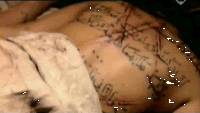
Born in Mogadishu, Somalia, in 1969 [the same year as my daughter], Ayaan Hirsi Ali gained international recognition as the controversial member of Dutch Parliament who wrote a short film attacking Islam, called Submission Part 1 (can be seen on YouTube).
In the film, images of bare women’s limbs are scrawled with verses of the Qu'ran which—Ali has said—denigrate and subordinate women. As a result of the film, its director, Theo van Gogh was killed in cold blood on the streets of Amsterdam, a note jabbed into his chest threatening Ms. Ali (and the United States to boot) with a fate like van Gogh’s. Van Gogh’s last words were, “Can’t we talk about this?” After the incident, Ms. Ali spent several months virtually kidnapped by her security team.